BPDP Signs First 2026 Replanting Batch: 5,682 Hectares Worth IDR 340 Billion, 50,000-ha Target
The first 2026 smallholder replanting (PSR) batch spans 11 provinces, led by Riau with 1,825.7 hectares. BPDP is aiming for 50,000 hectares this year.
Contents (3 sections)
Jakarta — The Plantation Fund Management Agency (BPDP) has signed the first batch of three-party smallholder replanting (PSR) agreements for 2026. The batch covers 5,682 hectares in 11 provinces and is worth about IDR 340 billion. BPDP Supervisory Board chair Dida Gardera announced the signing in Jakarta on Thursday, 29 January 2026. BPDP aims to fund replanting of 50,000 hectares over the whole of 2026.
Riau gets the largest share of the first batch
Forty-two disbursing institutions are taking part in the first batch. Thirty-eight of them come through the government channel and four through the partnership channel. BPDP is also working with 10 partner banks, which handle financing and support for farmers' plantations. "Phase I is spread across 11 provinces, with Riau having the largest PSR area," Dida said, as quoted by Warta Ekonomi and RMOL.
Investortrust published the provincial breakdown of the 42 agreements:
| Province | Agreements | Area (ha) |
|---|---|---|
| Riau | 6 | 1,825.70 |
| North Sumatra | 10 | 1,043.50 |
| Aceh | 5 | 859.31 |
| West Sumatra | 6 | 530.20 |
| South Sumatra | 2 | 423.62 |
| Jambi | 3 | 268.79 |
| Bangka Belitung | 3 | 185.54 |
| Lampung | 3 | 183.55 |
| West Kalimantan | 1 | 157.68 |
| Banten | 1 | 117.78 |
| Bengkulu | 2 | 86.36 |
The provincial figures add up to about 5,682 hectares, which matches the announced total.
A 50,000-hectare target after 2025 fell short of that level
RMOL reported Dida as saying that replanting in the previous year came in below 50,000 hectares, although he gave no exact figure. He said he was still confident the 2026 target could be met. To keep disbursements moving, he wants signings like this one to happen regularly. "Hopefully we can do this cooperation every two weeks," he said, according to Investortrust. By his own reckoning, signing about 5,000 hectares every two weeks would take the year-end total above 120,000 hectares. He presented this as an illustration, not as an official target.
BPDP released partial 2025 figures in November 2025. At the time, Normansyah Hidayat Syahruddin, BPDP's director of upstream fund disbursement, said the agency had received 198 technical recommendations from the Directorate General of Plantations by October 2025, ANTARA reported. Of these, 166 had been funded, covering 26,823 hectares, with IDR 804 billion going to 12,343 smallholders.
High FFB prices and land legality hold the programme back
BPDP pointed to several reasons why PSR struggles to meet its targets. The first is land status. Plots in the programme must be "clear and clean", meaning they lie outside forest areas and are free of overlapping claims. According to RMOL, sorting this out involves regional governments, the ministry responsible for forestry, and the Ministry of Agrarian Affairs and Spatial Planning (ATR/BPN). Stalled programmes are also handled by the Task Force for Accelerating Government Strategic Programmes (P2SP), which is led by Coordinating Minister for Economic Affairs Airlangga Hartarto and Finance Minister Purbaya Yudhi Sadewa.
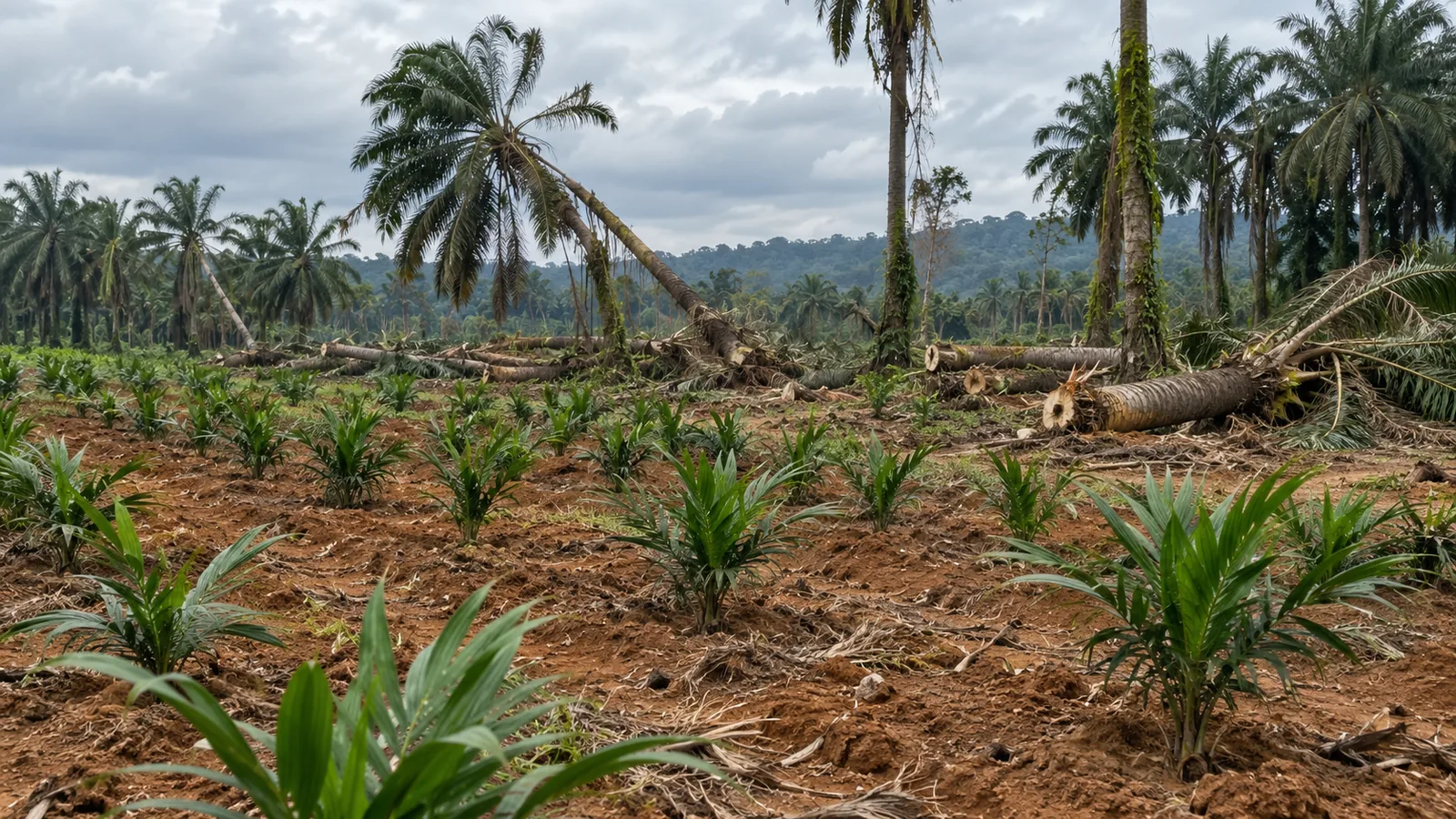
The second reason is price. Dida said fresh fruit bunch (FFB) prices in the regions were still high, at around IDR 3,500 per kilogram according to Investortrust. At that level, some farmers feel their old trees still earn enough and are reluctant to cut them down and replant. The problem is not new. In August 2025, BPDP President Director Eddy Abdurachman told Investortrust that PSR is voluntary, so it depends on farmers choosing to join. Since BPDPKS was set up, the replanting target has been 180,000 hectares a year. The best results were 94,000 hectares in 2019 and 90,000 hectares in 2020. Since then, replanting has averaged only about 40,000–50,000 hectares a year.
The third reason is limited outreach on the long-term benefits of replanting. Dida stressed that smallholder palm oil must be managed sustainably "and be traceable". PSR is one of the main tools for raising smallholder yields, and those yields in turn supply both the food industry and the biodiesel programme. FFB and CPO price movements can be tracked on our prices page.
Sources & references
- Investortrust, "BPDP Percepat Peremajaan Sawit 2026, Tahap I Jangkau 5.682 Ha" (29 January 2026) — https://investortrust.id/business/92958/bpdp-percepat-peremajaan-sawit-2026-tahap-i-jangkau-5682-ha
- RMOL, "BPDP Percepat Penyaluran PSR 2026 Kejar Target 50 Ribu Hektare" (29 January 2026) — https://rmol.id/bisnis/read/2026/01/29/695557/bpdp-percepat-penyaluran-psr-2026-kejar-target-50-ribu-hektare
- Warta Ekonomi, "BPDP Bidik Akselerasi Peremajaan Sawit Rakyat Capai 50 Ribu Hektare tahun 2026" (29 January 2026) — https://wartaekonomi.co.id/read598693/bpdp-bidik-akselerasi-peremajaan-sawit-rakyat-capai-50-ribu-hektare-tahun-2026
- ANTARA, "BPDP siapkan lima pendekatan percepat program PSR" (3 November 2025) — https://www.antaranews.com/berita/5217653/bpdp-siapkan-lima-pendekatan-percepat-program-psr
- Investortrust, "Harga Sawit Tinggi Jadi Penghambat Peremajaan Sawit Rakyat" (20 August 2025) — https://investortrust.id/business/76358/harga-sawit-tinggi-jadi-penghambat-peremajaan-sawit-rakyat