The Merah Putih Catalyst Explained: From ITB's Lab to an 800-Tonne Plant for D100 and Bio-Jet Fuel
Developed by ITB and Pertamina, the Merah Putih catalyst is used to make D100 diesel and J2.4 bio-jet fuel from palm oil. PT KSI now produces it in Cikampek: 800 tonnes a year, 13 products.
Contents (4 sections)
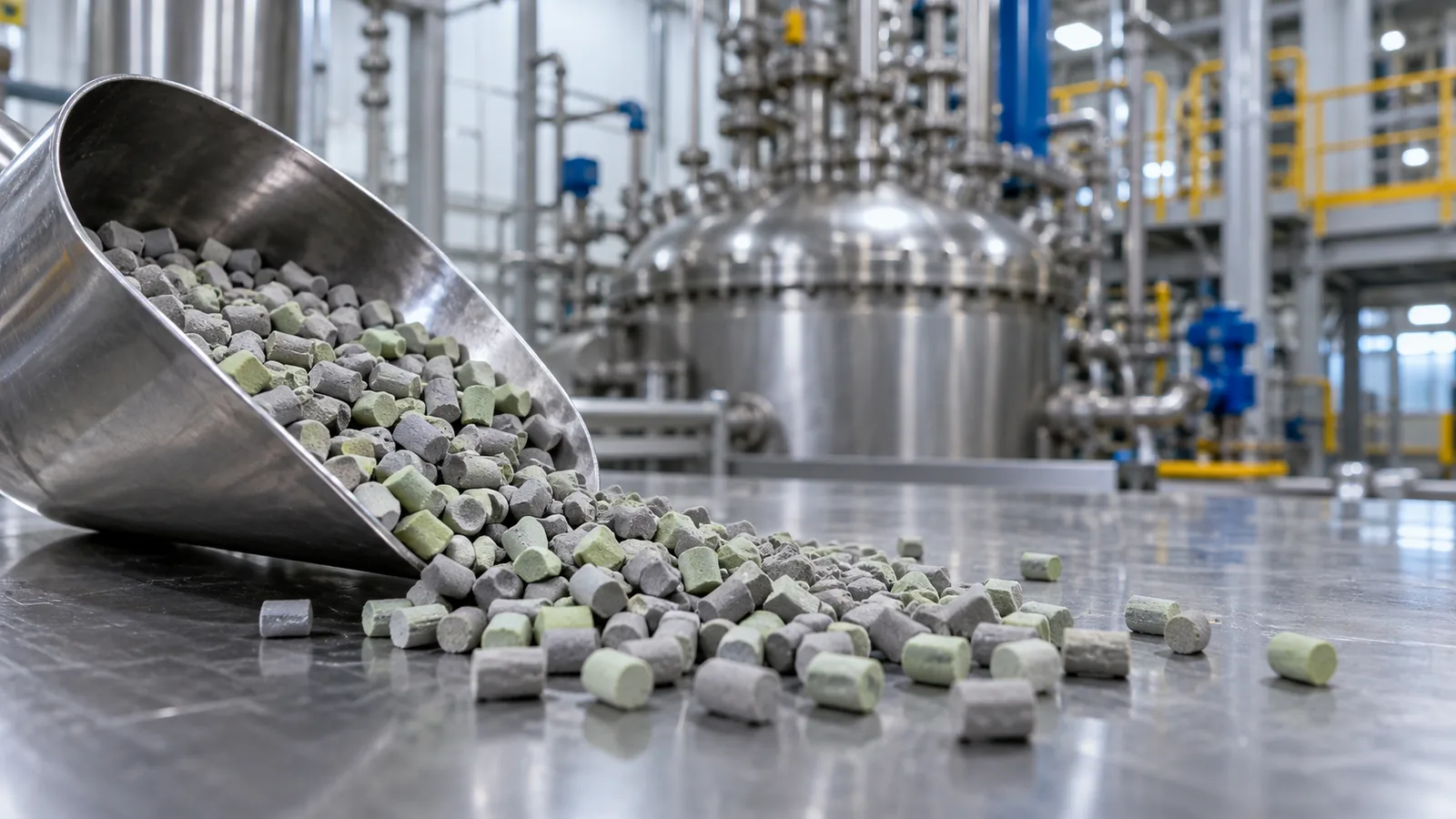
The Merah Putih catalyst is a catalyst developed by Institut Teknologi Bandung (ITB) together with Pertamina to convert palm oil and palm kernel oil into hydrocarbon fuels such as D100 green diesel and J2.4 bio-jet fuel. It is now produced by PT Katalis Sinergi Indonesia (KSI) in Cikampek, West Java, with a capacity of 800 tonnes a year; as of February 2025 its product range had reached 13 types. Here is a short guide to what a catalyst is, how the Merah Putih catalyst developed, and why it matters for Indonesia's biofuels.
What a catalyst is and why it matters
A catalyst is a substance that speeds up a chemical reaction without being used up by it. In biofuel production, catalysts help turn palm oil or castor oil into biodiesel, gasoline and aviation fuel, as explained in Antara's coverage of the Cikampek catalyst plant. In refineries, hydrotreating catalysts are used, among other things, to process palm oil into D100 diesel.
The problem is that Indonesia has long relied on imported catalysts. At the groundbreaking of the Merah Putih catalyst plant in March 2022, the Ministry of Energy and Mineral Resources (ESDM) put national catalyst demand at around USD 500 million a year, mostly met by imports, including roughly 18,000 tonnes a year for refineries, 1,500 tonnes for petrochemicals and 800 tonnes for oleochemicals. At the time, Indonesia had only one catalyst plant, operating under a German licence.
From ITB's laboratory to Pertamina's refineries
According to InfoSAWIT, ITB researchers began developing catalysts in 1982. ITB's Chemical Reaction Engineering and Catalysis (TRKK) laboratory, whose catalyst research team is led by Prof. Subagjo, later partnered with Pertamina's research unit. Key milestones include:
- From 2012: research by Pertamina RTI and ITB's Catalysis Engineering Center produced the Merah Putih catalyst to convert palm kernel oil into bio-jet feedstock (ESDM).
- December 2014: catalysts from the ITB team and Pertamina's research centre were tested at the RU II Dumai refinery to produce diesel from a mix of fossil and palm feedstocks via co-processing (InfoSAWIT).
- 11 October 2018: ITB launched a catalyst "Teaching Industry" producing catalysts to turn palm oil into biodiesel, bio-jet fuel and bio-gasoline (InfoSAWIT).
- 15 July 2020: the RU II Dumai refinery processed 100% refined palm oil (RBDPO) into D100 bio-hydrocarbon diesel using a catalyst made by ITB's TRKK and Pertamina.
- 2021: the RU IV Cilacap refinery blended refined palm kernel oil (RBDPKO) with kerosene and processed it over the Merah Putih catalyst, producing J2.4 bio-jet fuel that passed a CN235 flight test on the Bandung–Jakarta route (ESDM).
At that stage, ESDM noted, the catalyst was manufactured by Clariant Kujang Catalyst in Cikampek under the supervision of Pertamina RTI. The next step was a dedicated plant.
The Merah Putih catalyst plant in Cikampek
PT Katalis Sinergi Indonesia was established on 30 December 2020 to commercialise the Merah Putih catalyst. Its plant was built in the Kujang Cikampek Industrial Estate with an investment of around IDR 286 billion and is listed as a National Strategic Project.
| Aspect | Details |
|---|---|
| Shareholders | Pertamina Lubricants 38%, Pupuk Kujang 37%, Rekacipta Inovasi ITB 25% |
| Location | Kujang Cikampek Industrial Estate, Karawang, 2-hectare site |
| Capacity | 800 tonnes a year |
| Product range (Feb 2025) | 13 types: 9 hydrotreating catalysts, 4 oleochemical catalysts |
| New products in 2025 | SGB (Sulphur Guard Bed) adsorbent and ME-Kat 200 catalyst |
According to Antara, the plant made seven types of catalyst when it started operating, rising to 13 by February 2025. Hydrotreating catalysts help process palm oil into D100 diesel, while oleochemical catalysts serve a range of industries. The SGB product is used to remove sulphur at PT Kilang Pertamina Internasional's Kasim refinery in Papua, while ME-Kat 200 converts methyl esters into fatty alcohols used in paints, coatings and pharmaceuticals.
Why it matters for biodiesel and green fuels
The biodiesel blended into diesel under the mandatory programme is FAME (fatty acid methyl ester), whereas D100 and J2.4 are bio-hydrocarbon fuels processed in Pertamina's refineries. The Merah Putih catalyst is mainly relevant to this second pathway, including bio-gasoline research. Deputy Minister of Investment and Downstreaming Todotua Pasaribu, quoted by Antara, said catalyst needs had so far been met by imports and the plant was expected to make Indonesia self-reliant. He added that catalyst raw materials such as cobalt, nickel, zeolite, molybdenum and zinc are available domestically. Explanations of FAME and bio-hydrocarbons can be found in our glossary.
Sources & references
- Kementerian ESDM, "Pabrik Katalis Merah Putih Resmi Dibangun" (16 March 2022) — https://esdm.go.id/id/media-center/arsip-berita/pabrik-katalis-merah-putih-resmi-dibangun
- Kementerian ESDM, "Keberhasilan Uji Terbang Pesawat Berbahan Bakar Bioavtur, Langkah Strategis Pemanfaatan Energi Terbarukan di Sektor Transportasi Udara" (6 October 2021) — https://www.esdm.go.id/id/media-center/arsip-berita/keberhasilan-uji-terbang-pesawat-berbahan-bakar-bioavtur-langkah-strategis-pemanfaatan-energi-terbarukan-di-sektor-transportasi-udara
- InfoSAWIT, "Katalis Merah Putih: From Laboratory Research of ITB to Renewable Energy Production" (24 December 2023) — https://www.en.infosawit.com/news/13141/katalis-merah-putih--from-laboratory-research-of-itb-to-renewable-energy-production
- Antara, "Wamen Investasi: Hadirnya pabrik katalis dorong kemandirian energi" (26 February 2025) — https://gorontalo.antaranews.com/berita/302961/wamen-investasi-hadirnya-pabrik-katalis-dorong-kemandirian-energi
- detikFinance, "Perkuat Kemandirian Energi, KSI Produksi Perdana Katalis SGB & ME-Kat 200" (27 February 2025) — https://finance.detik.com/energi/d-7798316/perkuat-kemandirian-energi-ksi-produksi-perdana-katalis-sgb-me-kat-200