What Is ILUC? Why the EU Is Phasing Palm Biodiesel Down to Zero by 2030
ILUC is the risk that biofuel demand drives land conversion elsewhere. The EU uses it to freeze palm biodiesel at 2019 levels and remove it from targets by 2030.
Contents (4 sections)
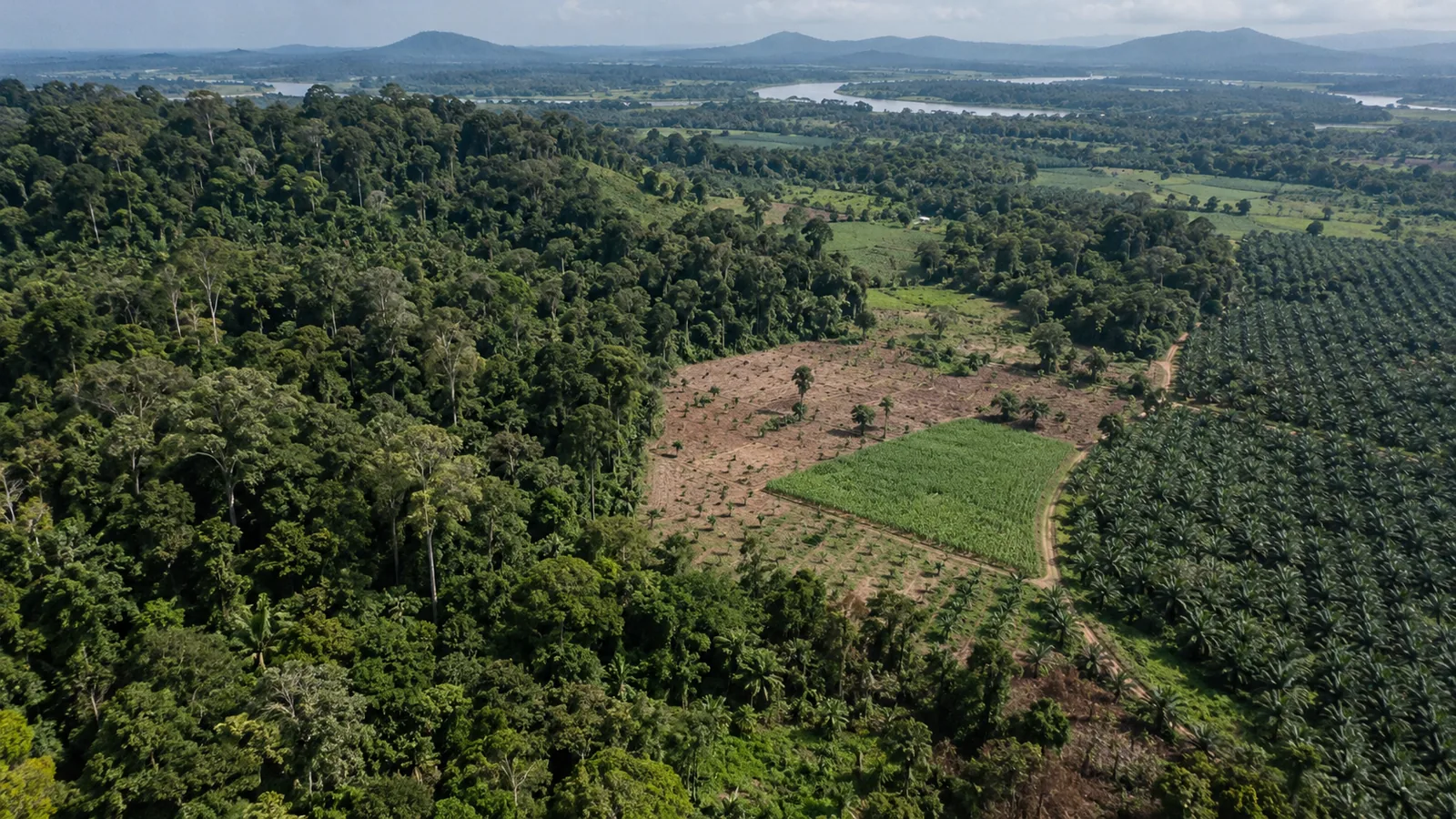
ILUC, or indirect land-use change, is the risk that demand for biofuel feedstock pushes agricultural expansion into forests or other high-carbon-stock land elsewhere. The European Union uses the concept to classify palm oil as a high ILUC-risk feedstock. As a result, palm biodiesel not certified as low-risk is capped at 2019 consumption levels, and its contribution to renewable energy targets must fall to zero by 2030. Indonesia challenged the rules at the WTO, and the dispute was still unfolding in 2026.
Direct versus indirect: what is the difference?
Direct land-use change happens when forest is cleared for the biofuel feedstock plantation itself. Indirect land-use change is harder to see: when existing farmland is diverted to supply biofuel, the food or feed it used to produce may drive new land clearing somewhere else.
According to a European Parliament resolution of 8 July 2026, the Renewable Energy Directive (Directive (EU) 2018/2001, RED II) introduced an ILUC framework to ensure that biofuels counting towards targets deliver genuine benefits. The methodology for identifying high-risk feedstocks is set out in Delegated Regulation (EU) 2019/807, which assesses land expansion "since 2008" and uses a threshold of 10% expansion into high-carbon-stock land. The Commission's 2019 report put soybean's share of such expansion at 8%, below the threshold, so soy was not classified as high-risk, while palm oil was.
How the cap works
An information note from Ireland to the EU Energy Council (October 2024) summarises the mechanism:
- Member States must cap the share of biofuels from high ILUC-risk feedstocks such as palm oil at 2019 levels, unless the products are certified as low-risk.
- By 31 December 2030, no high ILUC-risk palm oil supply may count towards the targets. Some Member States have opted for an earlier phase-out or an outright ban.
- Palm processing waste, namely POME and empty fruit bunches, is listed in Annex IX Part A as an advanced biofuel feedstock that counts double.
The European Commission's bioenergy page stresses that the limits cap what counts towards national targets; fuels above them can still be used and imported, and certified low ILUC-risk biofuels are exempt. The revised directive (EU) 2023/2413, or RED III, strengthens sustainability criteria and sets 2030 transport targets of either a 29% renewable share or a 14.5% cut in the emissions intensity of transport fuels, plus a combined 5.5% sub-target for renewable hydrogen and advanced biofuels.
The WTO dispute DS593
Indonesia challenged the framework at the WTO in dispute DS593. According to the EU's status report to the WTO Dispute Settlement Body (DSB), the DSB adopted its recommendations and rulings on 24 February 2025, and the reasonable period of time for implementation agreed by Indonesia and the EU expired on 24 February 2026.
The two sides read the ruling differently. According to the European Parliament resolution, the panel found broadly in the EU's favour but identified specific violations: failure to update scientific data in a timely manner, shortcomings in the low ILUC-risk certification procedure, and failure to notify measures. Trade Minister Budi Santoso, quoted by ANTARA on 25 February 2026, said the ruling confirms that EU policy is inconsistent with the WTO non-discrimination principle and urged the EU to comply promptly.
To implement the ruling, the Commission adopted a report on the expansion of food and feed crops on 20 January 2026 and opened a consultation on draft amendments to Regulation 2019/807 the following day. For low-risk certification, the EU points to Implementing Regulation (EU) 2022/996. The amended delegated regulation the Commission then adopted on 10 April 2026 also added soybean to the high-risk list, but on 8 July 2026 the European Parliament objected to it over the soy classification. In the same resolution, Parliament said it still supports the phase-down of palm biodiesel.
What it means for Indonesian biodiesel
| Aspect | Status according to official EU sources |
|---|---|
| Palm oil classification | High ILUC-risk under Delegated Regulation 2019/807 |
| Cap on target counting | Frozen at 2019 levels, falling to zero by end-2030 |
| Exemption route | Low ILUC-risk certification |
| Palm waste (POME, empty fruit bunches) | Advanced biofuel feedstock, counted double |
For producers targeting EU renewable energy goals, the remaining routes are low ILUC-risk certification or waste feedstocks such as POME. Even the waste route is now closely watched: in the same note, Ireland asked the Commission to investigate possible fraud because reported EU consumption of POME-based biofuels looked worrying relative to estimated global production potential. Related terms are explained in our glossary.
Sources & references
- European Commission, "Biofuels" (bioenergy page, accessed 2026) — https://energy.ec.europa.eu/topics/renewable-energy/bioenergy/biofuels_en
- European Parliament, P10_TA(2026)0252, resolution objecting to the ILUC delegated regulation (8 July 2026) — https://data.europarl.europa.eu/distribution/doc/TA-10-2026-0252_en.pdf
- Council of the European Union, "Biofuels supply from palm oil derivatives and fraud prevention – Information from Ireland" 14325/24 (9 October 2024) — https://data.consilium.europa.eu/doc/document/ST-14325-2024-INIT/en/pdf
- WTO, "Status Report by the European Union, Addendum" WT/DS593/19/Add.2 (10 April 2026) — https://www.italaw.com/sites/default/files/case-documents/trade/DS593/italaw18148346%20-%20European%20Union%20-%20Palm%20Oil%20-%20Status%20report%20by%20the%20European%20Union%20-%20Addendum%2C%20April%2010%2C%202026%20%28English%29.pdf
- ANTARA, "Indonesia calls on EU to enforce WTO decision on palm oil dispute" (25 February 2026) — https://en.antaranews.com/news/406046/indonesia-calls-on-eu-to-enforce-wto-decision-on-palm-oil-dispute