Biodiesel Feedstocks Beyond Palm Oil: 3 Million kL of Used Cooking Oil and Kemiri Sunan at 6–8 t/ha
Used cooking oil and kemiri sunan are often named as non-food biodiesel alternatives. Here is their potential, the official figures, and why neither has replaced palm oil.
Contents (3 sections)
Indonesia's biodiesel is made almost entirely from palm oil. According to GAPKI, the biodiesel sector used 12.704 million tonnes of palm oil in 2025, more than went into food. As demand keeps rising ahead of the planned B50 mandate, people are asking whether any other feedstock could avoid competing with food. The two candidates discussed most often are used cooking oil and kemiri sunan. Both have potential, and both face real obstacles.
Used cooking oil: large potential, hard to collect
Used cooking oil (UCO, or jelantah) is the frying oil left over by households, restaurants and the food industry. In April 2021, the Ministry of Energy and Mineral Resources (ESDM) estimated Indonesia's UCO potential at about 3 million kL a year. Hudha Wijayanto, then the ministry's subcoordinator for bioenergy engineering, said this could meet about 32% of national biodiesel needs. He set two conditions: biodiesel made from UCO must meet specification standards, and the business must be economically viable and workable in practice.
The problem is where the oil goes today. The ESDM release put palm cooking oil consumption at about 16.2 million kL. Only about 3 million kL of UCO was collected in 2019, and 2.43 million kL of that was recycled back into cooking oil for consumption. ESDM listed several other obstacles:
- UCO comes from many scattered sources, which makes it hard to process at an economic scale.
- Collection networks such as "oil banks" are expensive to build, so businesses look for partners, for example through large companies' CSR programmes.
- UCO's inherent properties make it hard to meet strict biodiesel quality standards.
- Some potential users, such as fishermen, hesitate to use UCO biodiesel because its colour differs from diesel and they fear engine damage.
ESDM analysis cited by CNN Indonesia says biodiesel cuts carbon emissions by 91.7% compared with diesel. The ministry also saw direct sales in closed schemes to end users, outside the national mandate, as a more realistic route for UCO. Since 8 January 2025, the government has also tightened UCO exports under Permendag 2/2025. UCO exports now need an allocation from an inter-ministerial coordination meeting. The stated aim is to secure domestic feedstock, including for the biodiesel programme.
Kemiri sunan: non-food and productive, but grown on little land
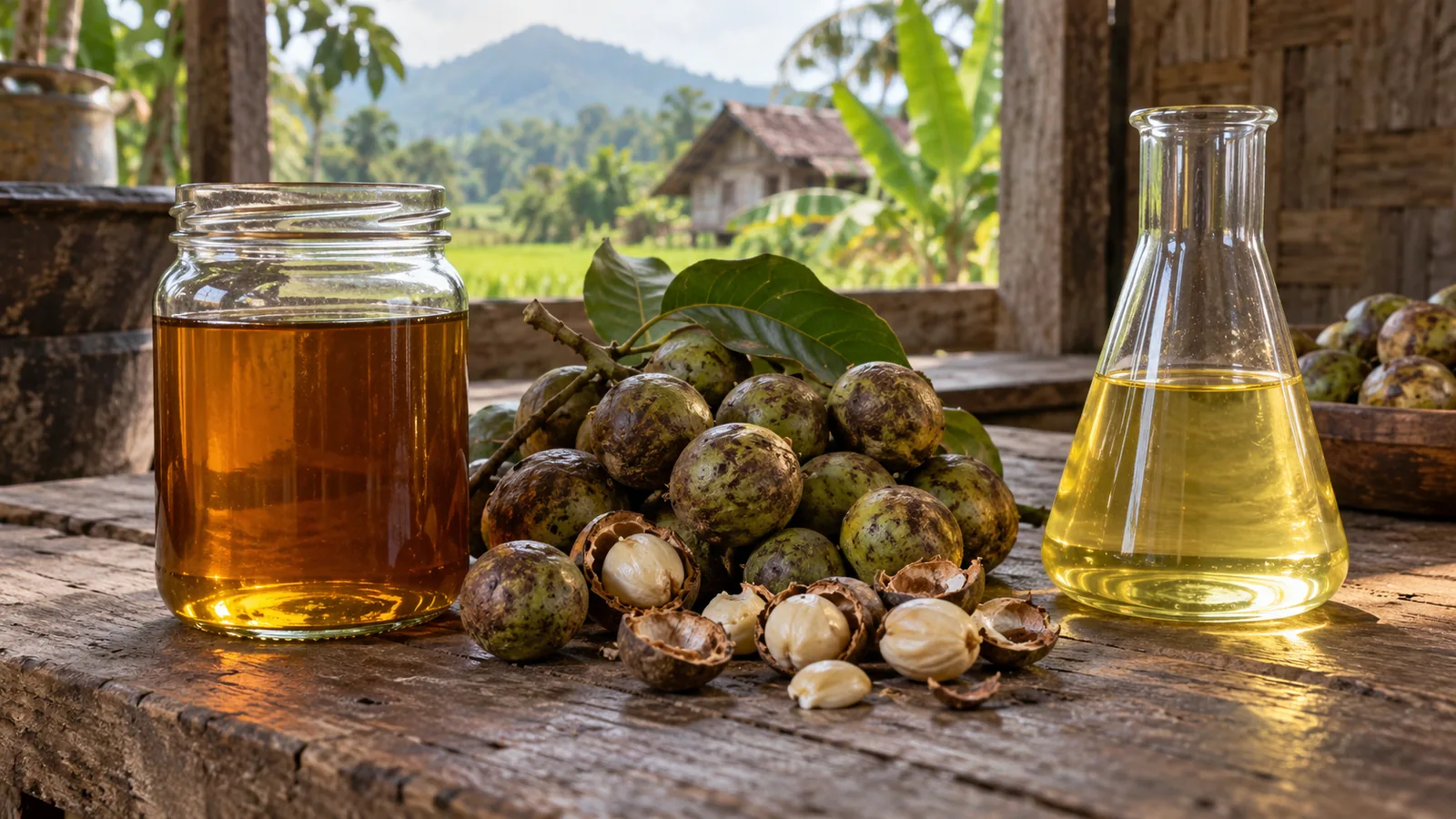
Kemiri sunan (Reutealis trisperma) is a tree with poisonous fruit. Because the fruit cannot be eaten, its oil does not compete with food. In a 2013 release, ESDM said the tree starts bearing fruit at about four years old and reaches peak output at about eight. The crude oil yield is about 52% of the seed kernel, and about 88% of that crude oil can be turned into biodiesel, with glycerol as the remainder. According to ESDM, one hectare with 100–150 trees can produce 6–8 tonnes of biodiesel a year. The tree's deep roots and dense canopy also make it useful for land conservation, including on former mining sites.
In April 2026, Evi Savitri Iriani, head of the Agriculture Ministry's institute for industrial and beverage crop assembly and testing, again described kemiri sunan as a non-food biodiesel candidate. "So for biodiesel production it is safe, because it is intended only for biodiesel," she said, as quoted by Katadata. Katadata also cited a journal estimate that palm oil yields about 4–5 tonnes per hectare a year. It added that kemiri sunan biodiesel has reportedly passed national quality standard tests, although the test parameters were not given.
The main obstacle is scale. In 2019, Republika reported, citing Agriculture Ministry data, that only about 1,000 hectares of kemiri sunan had been planted, mostly in West Java. Seeds can only be harvested for oil after 3–5 years. Productivity figures also vary. ESDM's then Director of Bioenergy put the figure at no less than 15 tonnes of oil source per hectare a year, while a researcher at Balittri, the Agriculture Ministry's research institute for industrial and beverage crops, cited 7 tonnes per hectare a year. The difference probably arises because they were measuring different things. At the time, the Indonesian Biofuel Producers Association (APROBI) said it had no data comparing kemiri sunan production costs with palm oil.
Other candidates and what they show
In 2019, APROBI's head of marketing and promotion, Togar Sitanggang, told Republika about other seeds that had been discussed as biodiesel sources: jatropha (jarak pagar), bintaro, nyamplung, kepuh and kapok (kapuk randu). Their problems follow a similar pattern. Supply is small and scattered, the plants take years to start producing, and the economics have not been proven at industrial scale.
| Feedstock | Strengths | Main constraints |
|---|---|---|
| Used cooking oil | A waste product that needs no new land; potential of about 3 million kL/year (ESDM) | Scattered collection, quality, competition from recycling and exports |
| Kemiri sunan | Poisonous, so non-food; 6–8 tonnes of biodiesel/ha/year (ESDM) | Only about 1,000 ha planted (2019); first harvest after 3–5 years |
| Jatropha, nyamplung, etc. | Non-food; can grow on marginal land | Small scale; economics untested |
For now, then, alternative feedstocks are better seen as a complement to palm oil than a replacement, at least in the near term. A bigger role would need reliable collection supply chains, enough planted land, and proof that the resulting biodiesel consistently meets quality standards. Technical biodiesel terms are explained in our glossary.
Sources & references
- Ministry of Energy and Mineral Resources (ESDM), "Ini Kiat Sukses Bidik Peluang Bisnis Energi dari Minyak Jelantah" (17 April 2021) — https://esdm.go.id/id/media-center/arsip-berita/ini-kiat-sukses-bidik-peluang-bisnis-energi-dari-minyak-jelantah
- CNN Indonesia, "Minyak Jelantah Diklaim Penuhi 32 Persen Kebutuhan Biodiesel" (18 April 2021) — https://www.cnnindonesia.com/ekonomi/20210418072218-85-631281/minyak-jelantah-diklaim-penuhi-32-persen-kebutuhan-biodiesel
- Ministry of Energy and Mineral Resources (ESDM), "Pengembangan Kemiri Sunan di Daerah Pertambangan" (14 December 2013) — https://www.esdm.go.id/id/media-center/arsip-berita/pengembangan-kemiri-sunan-di-daerah-pertambangan
- Republika, "ESDM: Pemanfaatan Kemiri Sunan Terkendala Suplai" (18 January 2019) — https://ekonomi.republika.co.id/berita/plis7l423/esdm-pemanfaatan-kemiri-sunan-terkendala-suplai
- Katadata, "Kemiri Sunan Berpotensi Jadi Kandidat Kuat Biodiesel Non-Pangan, Saingi Sawit?" (15 April 2026) — https://katadata.co.id/ekonomi-hijau/energi-baru/69df0d48e7276/kemiri-sunan-berpotensi-jadi-kandidat-kuat-biodiesel-non-pangan-saingi-sawit
- CNBC Indonesia, "Resmi! Ekspor Minyak Jelantah-Limbah Sawit Diperketat, Ini Aturannya" (10 January 2025) — https://www.cnbcindonesia.com/news/20250110115753-4-602225/resmi-ekspor-minyak-jelantah-limbah-sawit-diperketat-ini-aturannya
- InfoSAWIT, "Indonesia's Palm Oil Production Reaches 56.55 Million Tons in 2025, Export Value Jumps to US$35.87 Billion" (17 March 2026) — https://www.en.infosawit.com/news/17423/indonesia---s-palm-oil-production-reaches-56-55-million-tons-in-2025--export-value-jumps-to-us-35-87-billion