Counting Palm Biodiesel Emissions: Reading the 38.88 Million Tonne CO₂e Claim and Land-Use Change
Indonesia says B40 cut 38.88 million tonnes of CO₂e in 2025. The climate benefit of palm biodiesel hinges on POME methane capture and where plantations were planted.
Contents (4 sections)
The Ministry of Energy and Mineral Resources (ESDM) recorded 14.2 million kL of B40 biodiesel use in 2025 and claims the programme cut emissions by 38.88 million tonnes of CO₂ equivalent. A number that large depends on how it is calculated. Emission savings from palm biodiesel are measured by comparing the biofuel's life-cycle emissions with those of the fossil diesel it replaces, and the result can swing dramatically on two questions: whether methane from palm oil mill waste is captured, and whether emissions from land clearing are counted.
Where does the 38.88 million tonnes come from?
The claim was presented at ESDM's 2025 performance briefing in Jakarta on 8 January 2026, as reported by InvestorTrust. Besides the emission cut, the government cited foreign exchange savings of IDR 130.21 trillion and IDR 20.43 trillion in added value from processing CPO into biodiesel. The 14.2 million kL realised equals 105.2% of the 13.5 million kL performance target.
Divided simply, the claim works out to roughly 2.7 tonnes of CO₂e per kL of biodiesel (our calculation). Media reports on the briefing did not detail the methodology, such as the emission factor used for the diesel comparator or the system boundary. The figure is therefore best read as an official government claim rather than the result of an independent audit.
Three upstream sources of biodiesel emissions
A life cycle assessment (LCA) tracks emissions from plantation to tank. EU default values for palm biodiesel, for example, add up emissions from the following stages:
- Cultivation: all plantation activity up to the harvest of fresh fruit bunches (FFB).
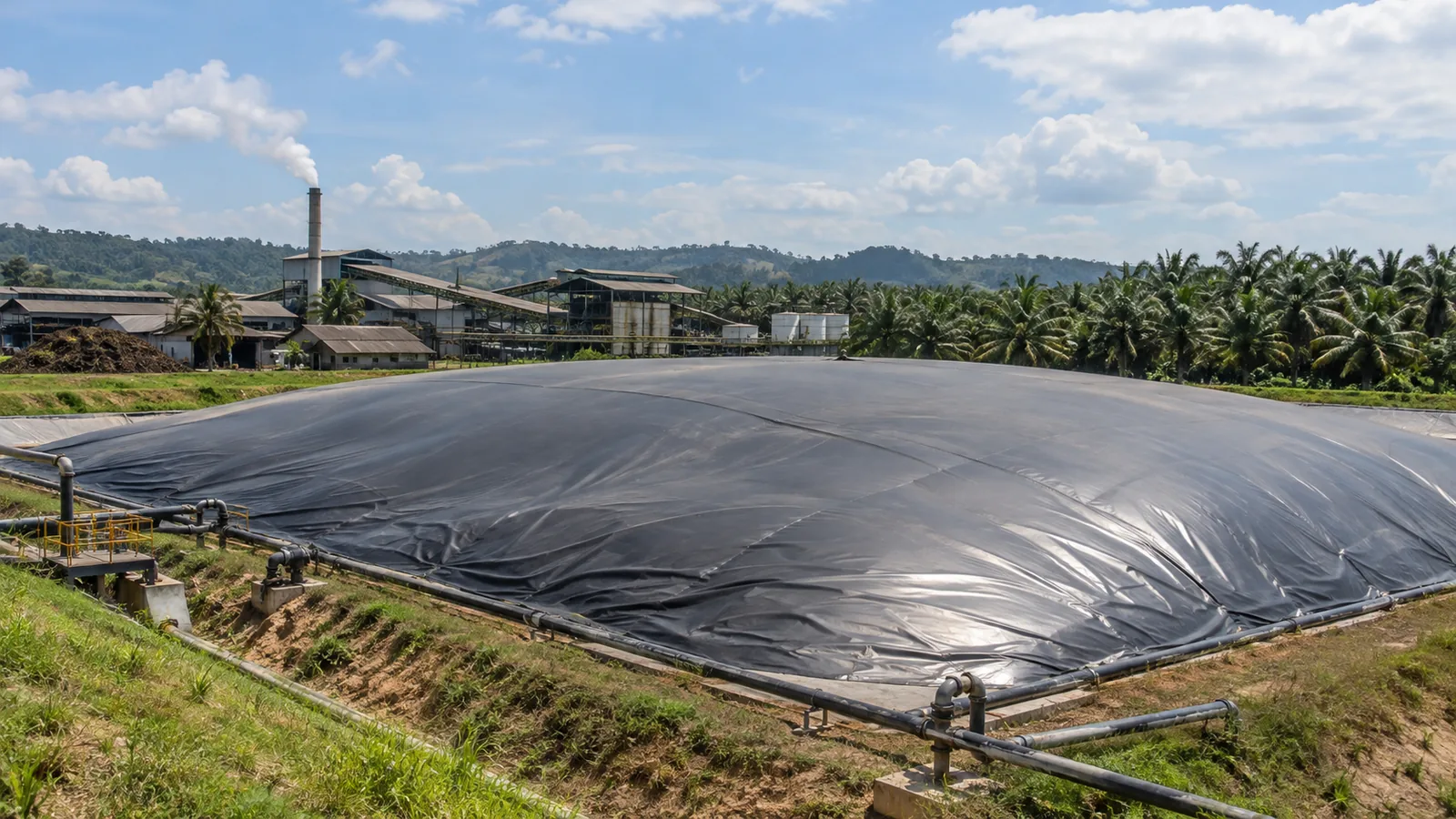
- Processing at the palm oil mill: notably methane from palm oil mill effluent (POME). According to ESDM, each tonne of FFB generates 600–700 litres of POME. Anaerobic breakdown of this effluent produces methane-rich biogas, which covered lagoons or CSTR reactors can capture for power generation.
- Transport and distribution: moving feedstock and biodiesel to the blending point.
The impact of methane capture is visible in EU rules. An RSPO-RED document (2012) explains that under the first Renewable Energy Directive, only the default values for palm biodiesel with methane capture at the mill met the minimum 35% emission-saving requirement. The aggregated default was 37 g CO₂e per megajoule, equivalent to a 56% saving, and operators using it had to show evidence that POME biogas was actually captured.
The decisive factor: land-use change
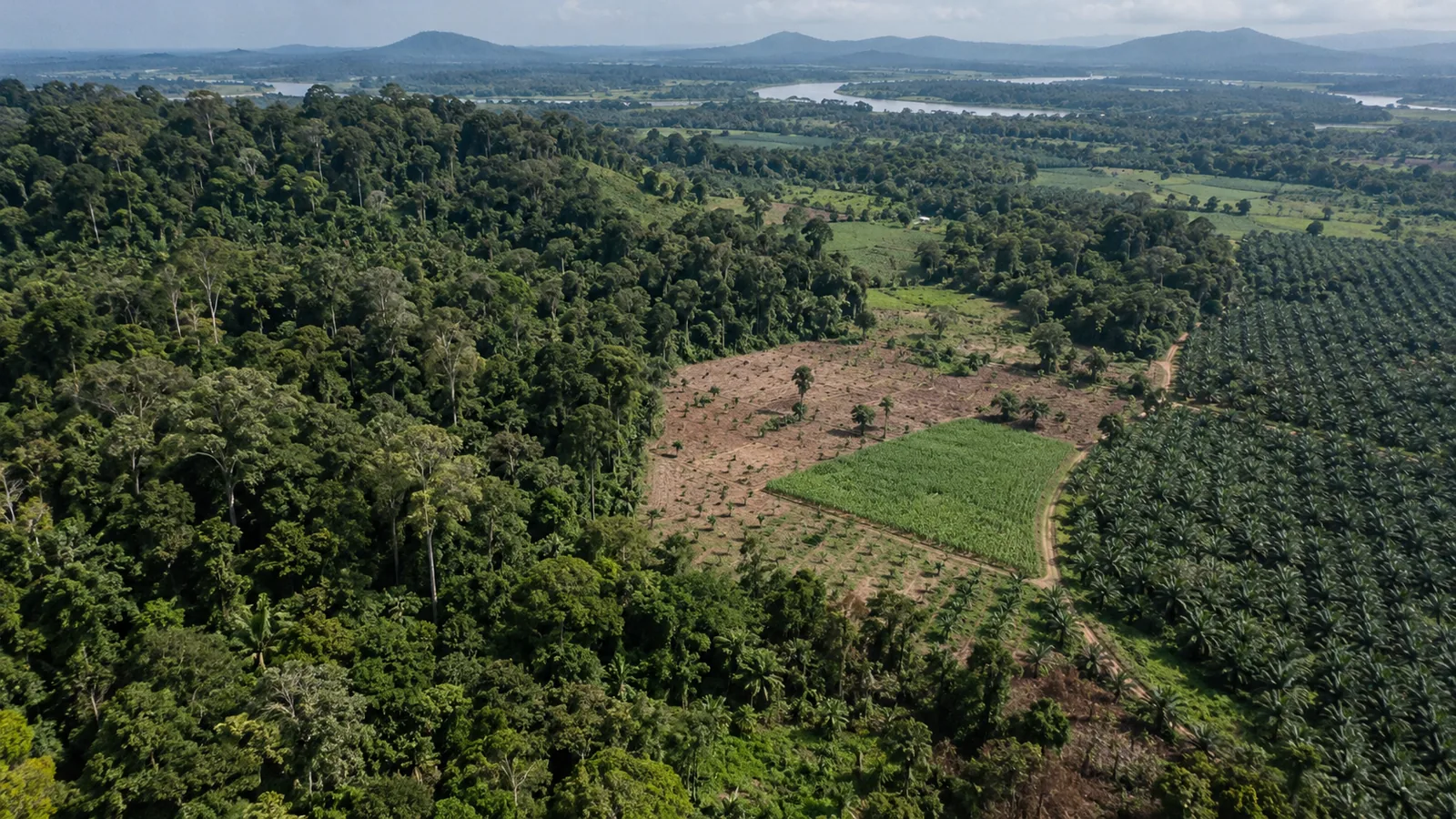
The calculation changes if plantations come from cleared forest or peat. Dialogue Earth, in a report republished by Project Multatuli (November 2024), cited a 2017 Cerulogy study. Ignoring land carbon, it found a net benefit for palm biodiesel of about 5–7 tonnes of CO₂ per hectare per year. If plantations come from converting forested peatland, however, net emissions instead rise by about 120 tonnes of CO₂ per hectare per year.
In the same report, IESR research manager Raditya Yudha Wiranegara stressed that emissions must be counted holistically, from upstream to downstream. The national context matters: according to Indonesia's 2022 enhanced NDC, cited in the report, the land sector accounted for 50.13% of Indonesia's 2019 emissions, more than energy (34.49%).
The European Union builds this risk into its rules through the concept of indirect land-use change (ILUC). An information note from Ireland to the EU Energy Council (October 2024) explains that consumption of biofuels from high ILUC-risk feedstocks such as palm oil is capped at 2019 levels and must fall to zero by 31 December 2030 unless certified as low-risk. POME, by contrast, is listed in Annex IX Part A as an advanced biofuel feedstock that counts double.
Summary: what makes emission figures differ
| Factor | Effect on the result |
|---|---|
| POME methane capture | Determines whether palm biodiesel clears emission-saving thresholds under EU schemes |
| Land origin (forest, peat, long-established plantation) | Can turn a net benefit into additional emissions |
| System boundary and diesel emission factor | Determines the size of national claims such as 38.88 million tonnes CO₂e |
In other words, government claims and environmental critics can both start from accurate data yet use different calculation boundaries. Related technical terms can be found in our glossary.
Sources & references
- InvestorTrust, "Mandatori B40 Bikin Indonesia Tekan Impor Solar, Hemat Devisa Rp 130,21 Triliun" (9 January 2026) — https://investortrust.id/business/90818/mandatori-b40-bikin-indonesia-tekan-impor-solar-hemat-devisa-rp-130-21-triliun
- Project Multatuli/Dialogue Earth, "Will Indonesia's biodiesel push put its climate goals at risk?" (19 November 2024) — https://projectmultatuli.org/en/will-indonesias-biodiesel-push-put-its-climate-goals-at-risk/
- RSPO, "RSPO-RED Requirements for compliance with the EU Renewable Energy Directive requirements, Version 4" (10 February 2012) — https://rspo.org/wp-content/uploads/rspo-red-requirements-english.pdf
- Ministry of Energy and Mineral Resources, "Limbah Sawit di Indonesia Berpotensi Hasilkan Listrik 12.654 MW" (24 January 2018) — https://www.esdm.go.id/id/media-center/arsip-berita/limbah-sawit-di-indonesia-berpotensi-hasilkan-listrik-12654-mw
- Council of the European Union, "Biofuels supply from palm oil derivatives and fraud prevention – Information from Ireland" 14325/24 (9 October 2024) — https://data.consilium.europa.eu/doc/document/ST-14325-2024-INIT/en/pdf