LEMIGAS Details B35 Quality and Fuel-Filter Tests
Indonesia's testing centre detailed filtration and stability checks after B35 began; the release did not include a full results table.
Contents (3 sections)
Jakarta — Indonesia's oil and gas testing centre LEMIGAS described its quality checks on B35 biodiesel blends on 13 February 2023, including tests for possible fuel-filter blockage. The statement came after the 35% biodiesel blend began to be implemented on 1 February. LEMIGAS said B35 had passed its quality assessment, but the release did not publish a full table of measured results or evidence from every diesel vehicle in daily service.
Why filtration was examined
According to the Ministry of Energy and Mineral Resources (ESDM), the laboratory examined moisture absorption, solvent effects, oxidation stability and the potential for deposits. Raising the biodiesel component from B30 to B35 makes fuel handling and storage important alongside the blend itself. A test result for a sample at a laboratory should not automatically be read as a guarantee about every distribution point or fuel tank.
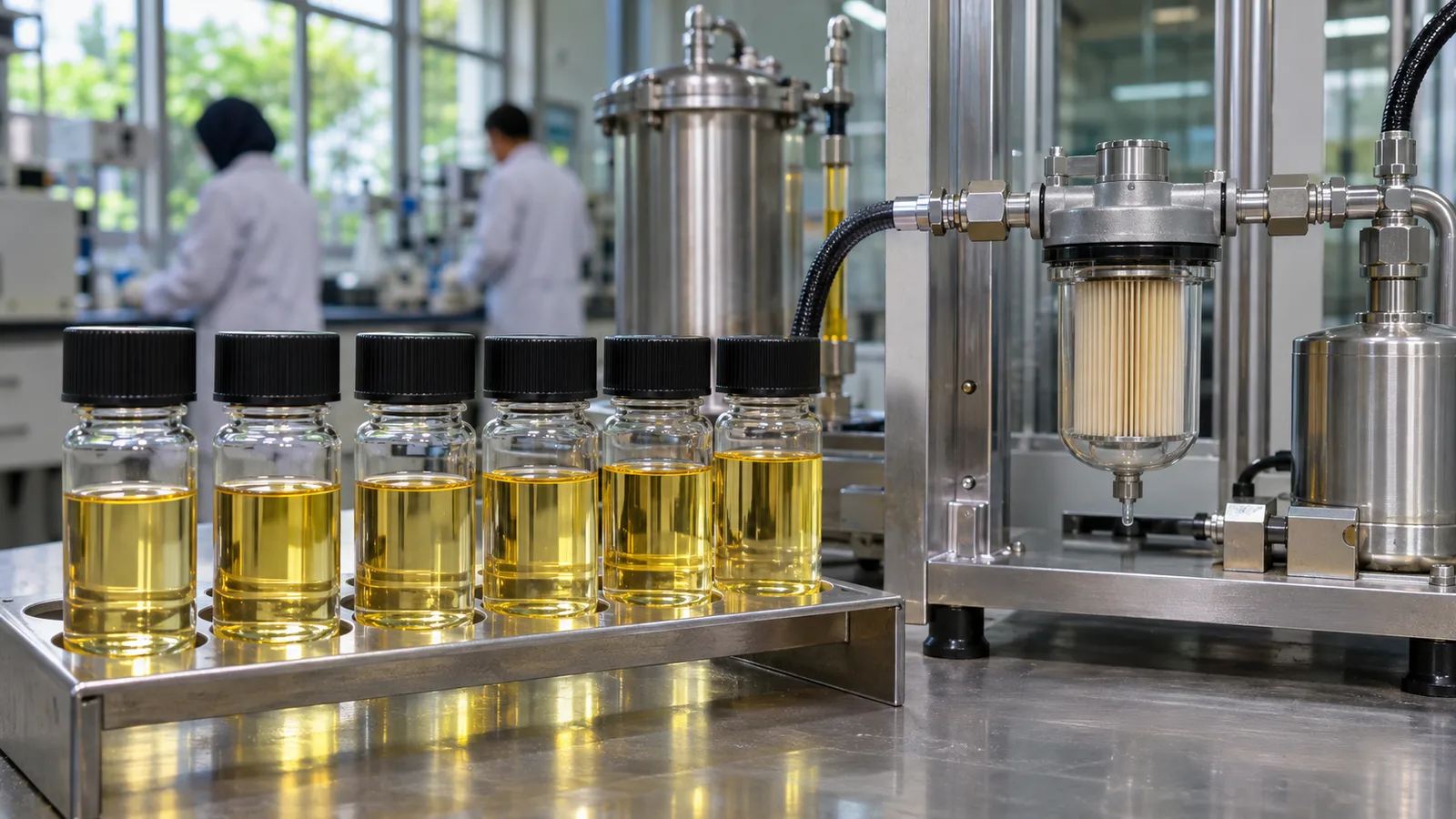
LEMIGAS applied a Filter Blocking Tendency (FBT) test to evaluate the likelihood that fuel might restrict flow through a filter. The ministry said this test measures pressure and flow, with reference to ASTM D2068. It also described particle sizing and counting, sometimes referred to as a fuel cleanliness test. The release cited ISO 4406 for the cleanliness code and ASTM D7619 for particle-counting methods.
The ministry listed particle-size categories below 4, 6 and 14 micrometres. Those measurements matter to an assessment of filtration, yet the release did not set out numerical readings for each sample. Readers therefore cannot calculate a B30-versus-B35 performance difference from that statement. Passing a laboratory assessment is LEMIGAS's reported conclusion, not a forecast of filter life across all engines.
Tests preceded the rollout
In a report published on 13 January 2023, ANTARA quoted ESDM official Dadan Kusdiana saying deliveries to the B35 specification were being prepared ahead of the national implementation date. He said preparatory filtration checks had found no sign of blockage in FBT and Filter Rig Test (FRT) trials. This refers to the government's test programme; it is not a survey of all diesel equipment in service.
ANTARA also reported that the ministry was paying attention to production quality and fuel handling from transport to blending. In the February release, LEMIGAS head Ariana Soemanto said testing should continue, together with improvements in fuel handling and storage. She mentioned cold-flow improvers as a possible way to improve the low-temperature flow properties of B35; the release did not say that every B35 shipment contained such an additive.
What the findings do and do not establish
B35 combines diesel with 35% biodiesel. Filter, particle and stability tests consequently bear directly on Indonesia's biofuel blending programme. As of 13 February 2023, the available releases support a limited account: filtration had been investigated before the mandate began, and the testing centre subsequently detailed aspects of its quality oversight.
Neither opened report provides the complete sample data, a vehicle-by-vehicle durability study or a universal promise against filter trouble. Operators should distinguish between laboratory observations and conditions in storage, distribution and individual machines. The need to maintain quality throughout that chain remains even when a blend meets a laboratory specification. See the biodiesel mandate timeline for the policy context and the glossary for terminology.
Sources & references
- ESDM, "LEMIGAS Siap Jaga Kualitas Mutu B30 dan B35" (13 February 2023) — https://www.esdm.go.id/id/media-center/arsip-berita/lemigas-siap-jaga-kualitas-mutu-b30-dan-b35
- ANTARA, "KemenESDM: Seluruh pengiriman biodiesel pakai B35 mulai pekan depan" (13 January 2023) — https://www.antaranews.com/berita/3348042/kemenesdm-seluruh-pengiriman-biodiesel-pakai-b35-mulai-pekan-depan
Stay on top of Indonesian biodiesel
The weekly newsletter: the week’s key news, prices and data in one email every Friday. Or follow our channels for daily prices.