Research Brief: UGM — B50 Climate Benefit Hinges on a 28% Land-Expansion Limit
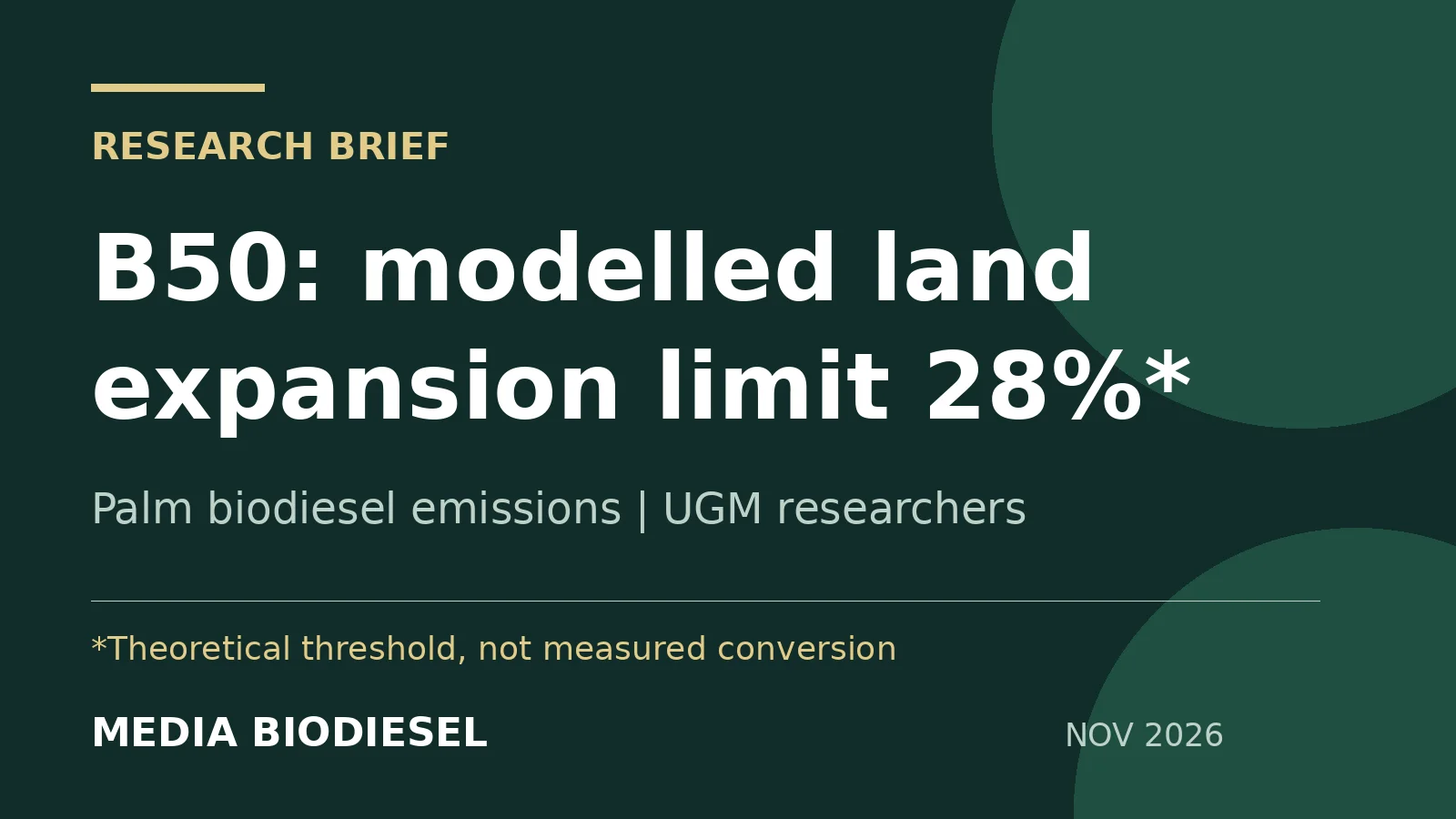
UGM researchers model a theoretical 28% limit for incremental feedstock from forest-conversion-equivalent land, not measured expansion.
Contents (3 sections)
Jakarta — A study by Universitas Gadjah Mada researchers Aqli Sharfan, Anju Gerald and Sebastianus Pranindityo, published on 4 November 2026 in the International Journal of Oil Palm, models a land-expansion threshold for the extra palm feedstock needed when Indonesia moves from B40 to B50 biodiesel. Under the paper's mineral-soil forest-conversion scenario, the greenhouse-gas benefit disappears if more than roughly 28% of incremental feedstock comes from high-emissions converted land. This is a theoretical threshold, not a measurement of Indonesia's current plantation expansion share.
Main finding: diesel displacement is not the same as emissions savings
The authors use a fossil-diesel comparator of 94 grams of CO₂-equivalent per megajoule (g CO₂e/MJ) and a non-land-use-change palm biodiesel core intensity of 46–52 g CO₂e/MJ for processing with mill-effluent methane capture. Their central land-use-change break-even is approximately 44 g CO₂e/MJ, ranging from 37 to 53 when the comparator and biodiesel factors vary (equations and Table 3, journal pages 14–18). They use 156 g CO₂e/MJ as an example of measured mineral-soil forest-conversion emissions. On marginal allocation, at most about 28% of additional feedstock could come from land with that conversion-equivalent intensity before the modelled climate benefit disappears. Charging all conversion emissions to B50 instead yields a precautionary threshold near 6%. Those are different accounting questions, not observed areas of cleared forest.
With low-land-use-change sourcing, the model shows a 5.6% reduction in fuel-cycle greenhouse-gas intensity compared with B40, falling to about 2.8% if a 3% engine-efficiency penalty occurs. In a mining-equipment stress test, it calculates fossil-diesel displacement of 0.0335 litres per bank cubic metre of overburden moved after equalising delivered energy (equations 1–3, pages 14–15). That operating unit is not a national import-saving estimate and does not make coal mining low-carbon. Its full-year B50 scenario assumes 20.1 million kL of biodiesel versus 15.6 million kL under B40, implying an additional 4.06 million tonnes of crude palm oil (CPO) a year (equation 9 and Table 4, pages 17–20). This is a full-year scenario, not actual 2026 consumption.
Method and limitations
The authors describe a scenario-based operational fuel-cycle screen assembled from published emission factors, not a complete third-party-reviewed life-cycle assessment. They compare B40 and B50 at equal delivered energy, then test the land-use emissions of marginal feedstock. Mining overburden provides an operational denominator; it does not determine the land-use threshold. A higher-intensity open-pond milling pathway, about 76 g CO₂e/MJ before land-use change, is considered separately (methods and Tables 1–3, pages 13–18).
Authors' stated limitations: the paper collected no primary plantation inventory or fleet measurements and did not measure the actual share of new feedstock from converted land. The engine penalty is a sensitivity assumption rather than an observed B50 fleet result. Peat conversion is not separately parameterised, while indirect land-use change is not modelled endogenously. The 156 g case is one mineral-soil conversion example, not the average intensity of Indonesian plantations. The paper also does not test farmer income or certification outcomes (Limitations, page 22).
What it means for Indonesia: other estimates use different scopes
Editor's note: the paper's introduction still refers to B50 as deferred, whereas Indonesia's Ministry of Energy and Mineral Resources (ESDM) reported launching the mandate on 9 July 2026. Its policy-status wording is therefore outdated. ESDM projected biodiesel demand of 16.7–18 million kL, CPO needs of 15.2–16.3 million tonnes, and avoided emissions of 44.46 million tonnes of CO₂ under implementation. Those government projections use different boundaries and units from the paper's per-MJ break-even; they cannot simply be equated or reconciled here.
The Indonesian Palm Oil Association (GAPKI), in a July presentation, estimated that B50 in 2026 would require about 1.9 million tonnes more CPO than the 2025 B40 allocation, for total needs around 14.6 million tonnes. That differs from the paper's 4.06-million-tonne increment for a full annual B40-to-B50 step. The periods, baselines and assumed volumes differ; neither figure should be presented as the other's realised outcome. The practical question the study raises is where marginal CPO comes from and whether its land history can be documented. Increasing the nominal blending percentage alone cannot answer it.
Sources & references
- Sharfan et al., “Expansion-Share Threshold for Indonesia's B50 Palm Biodiesel” (4 November 2026) — https://www.ijop.id/index.php/ijop/article/download/214/89
- Kementerian ESDM, “Luncurkan Mandatori B50, ESDM Tegaskan Kesiapan Indonesia Perkuat Kedaulatan Energi” (9 Juli 2026) — https://www.esdm.go.id/id/media-center/arsip-berita/luncurkan-mandatori-b50-esdm-tegaskan-kesiapan-indonesia-perkuat-kedaulatan-energi
- GAPKI, “Prospek Industri Sawit Indonesia 2026: Dampak Kebijakan Baru terhadap Pasokan, Permintaan, dan Biaya” (28 Juli 2026) — https://gapki.id/news/2026/07/28/prospek-industri-sawit-indonesia-2026-dampak-kebijakan-baru-terhadap-pasokan-permintaan-dan-biaya/
Stay on top of Indonesian biodiesel
The weekly newsletter: the week’s key news, prices and data in one email every Friday. Or follow our channels for daily prices.