Cloud Point and CFPP: Why Palm Biodiesel (17 °C Cloud Point) Is Sensitive to Cold
Biodiesel can cloud and clog filters as temperatures fall. Understand cloud point, CFPP and pour point, why palm is more sensitive, and Indonesia's cold-start tests from B30 to B50.
Contents (4 sections)
Biodiesel can turn cloudy and clog filters when temperatures fall below a certain point, because some of its molecules begin to crystallise. Three figures are used to measure this behaviour: the cloud point, the cold filter plugging point (CFPP) and the pour point. Palm biodiesel has a cloud point of around 17 °C in data from Farm Energy (Extension), higher than soybean or canola biodiesel. That is why the ability of engines to start in cold areas is always tested before a new blending mandate is introduced in Indonesia.
Cloud point, CFPP and pour point
According to a Farm Energy guide from the US Extension network, written by John Nowatzki and colleagues, the three parameters are defined as follows:
- Cloud point: the temperature at which small solid crystals first appear as the fuel cools, making it look hazy.
- CFPP: the temperature at which a fuel filter becomes plugged by crystallised or gelled components. Because the test is expensive and tedious, cloud point and pour point are often used to bracket the CFPP.
- Pour point: the lowest temperature at which the fuel still moves when its container is tipped.
The same guide notes that the gap between cloud point and pour point in biodiesel is only a few degrees, compared with about 20 degrees for fossil diesel. In other words, biodiesel can move from liquid to gel over a narrow drop in temperature.
Why palm biodiesel is more sensitive
Cold-flow behaviour depends heavily on feedstock. Farm Energy says biodiesel from different feedstocks can differ by as much as 15 °C. The guide links cold-flow problems to saturated methyl esters, which have high melting points and crystallise easily; in its table, palm biodiesel has the highest cloud and pour points.
| Biodiesel feedstock | Cloud point (°C) | Pour point (°C) |
|---|---|---|
| Palm | 17 | 15 |
| Tallow | 12–17 | 6 |
| Jatropha | 8 | 6 |
| Soybean | 1 | 0 |
| Canola | 0 | -9 |
For comparison, the US Department of Energy's Alternative Fuels Data Center (AFDC) lists a general B100 cloud point range of -3 to 15 °C and a pour point range of -5 to 10 °C. The palm figures in the Farm Energy table sit above that general range. In Indonesia, the SNI 7182:2015 biodiesel specification sets a maximum cloud point of 18 °C, according to a presentation on Indonesia's biodiesel specification published by the APEC energy forum EGNRET.
The effect of the blend ratio
Vehicles in Indonesia do not run on B100 but on blends with diesel. A 2020 Lemigas study of palm biodiesel blended with Minyak Solar 48 and Minyak Solar 51 found that the blend ratio significantly affects cloud point and CFPP, explaining more than 96.7% of the variation in both. The cold-flow properties of a blend can even be predicted from the cloud point or CFPP of the base diesel and the blend ratio.
AFDC says blends with smaller shares of biodiesel generally perform better in cold weather; B5 performs roughly like ordinary diesel. In countries with cold winters, suppliers add cold flow improvers. However, Farm Energy notes that such additives mainly lower the pour point rather than the cloud point. Other measures mentioned in the guide include fuel line or tank heaters, insulated filters and lines, and blending with another biodiesel that has a lower cloud point.
Cold tests in Indonesia's highlands
Indonesia has a tropical climate, but its mountain areas are still used to test whether engines can start on cold mornings (cold startability):
- B30 (2019): vehicles running on B0 and B30 were left to stand for 3, 7, 14 and 21 days and all started normally in about 1 second, according to the Ministry of Energy and Mineral Resources (ESDM).
- B40 (October 2022): testing at the Tambi plantation in Wonosobo, 1,400 metres above sea level. The standard requires an engine to start within 5 seconds; the B40 and B30D10 formulas passed, with the fastest start at about 1 second.
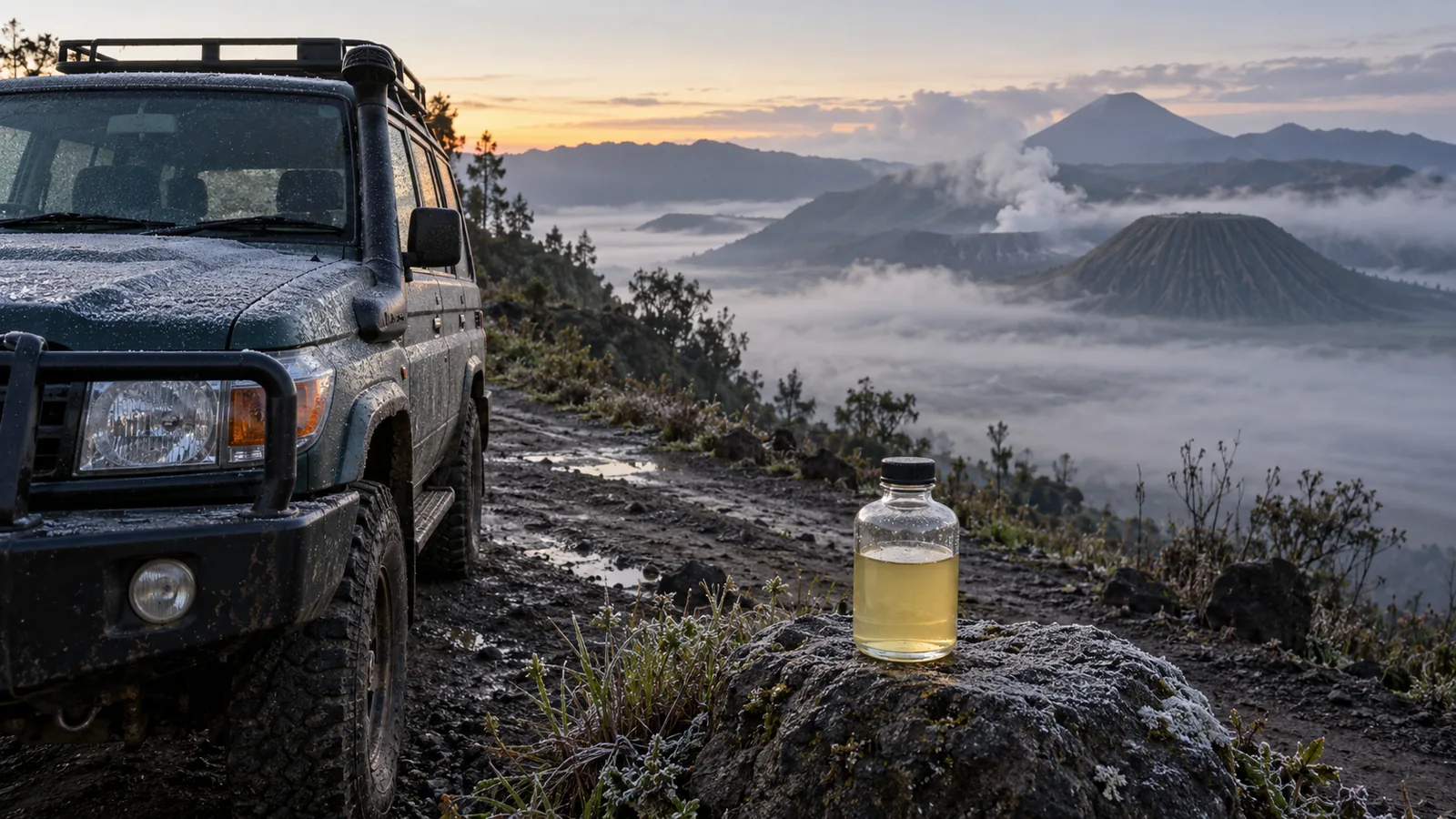
- B50 (2026): EBTKE Director General Eniya Listiani Dewi, quoted by CNBC Indonesia on 2 June 2026, said the engine at Bromo started in under one second, even 0.8 seconds. The test temperature was not given.
These tests measure the ability to start, not CFPP directly. For users, the practical rule is to follow the manufacturer's fuel recommendations and keep an eye on filter condition. Other biodiesel technical terms can be checked in our glossary.
Sources & references
- Farm Energy (Extension), "Biodiesel Cloud Point and Cold Weather Issues" (updated 12 April 2019) — https://farm-energy.extension.org/biodiesel-cloud-point-and-cold-weather-issues
- U.S. Department of Energy, Alternative Fuels Data Center, "Biodiesel Basics" — https://afdc.energy.gov/fuels/biodiesel_basics.html
- Lembaran Publikasi Minyak dan Gas Bumi (Lemigas), "Pengaruh Biodiesel Berbasis Minyak Kelapa Sawit terhadap Cold-Flow Properties Minyak Solar 48 dan Minyak Solar 51" (2 August 2020) — https://journal.lemigas.esdm.go.id/index.php/LPMGB/article/view/500
- APEC EGNRET, "Biodiesel Specification in Indonesia" (2017) — https://www.egnret.ewg.apec.org/Upload/2025051211260903561f1.pdf
- Kementerian ESDM, "Uji Jalan Selesai, Kementerian ESDM Umumkan Rekomendasi Teknis Mandatori B30 di 2020" (28 November 2019) — https://esdm.go.id/id/media-center/arsip-berita/uji-jalan-selesai-kementerian-esdm-umumkan-rekomendasi-teknis-mandatori-b30-di-2020
- Kementerian ESDM, "Ini Hasil Uji Cold Startability B40 di Dataran Tinggi" (26 October 2022) — https://www.esdm.go.id/id/media-center/arsip-berita/ini-hasil-uji-cold-startability-b40-di-dataran-tinggi
- CNBC Indonesia, "Siap-siap! RI Punya BBM Baru B50 Bulan Depan" (2 June 2026) — https://www.cnbcindonesia.com/news/20260602112625-4-739362/siap-siap-ri-punya-bbm-baru-b50-bulan-depan