Fact Check: Did the EU Ban Indonesia From Producing B50 Biodiesel? — False
A YouTube video claimed the EU banned B50 production. There is no such ban; the EU restricts palm biofuel in its own market, a policy Indonesia contests at the WTO.
Contents (4 sections)
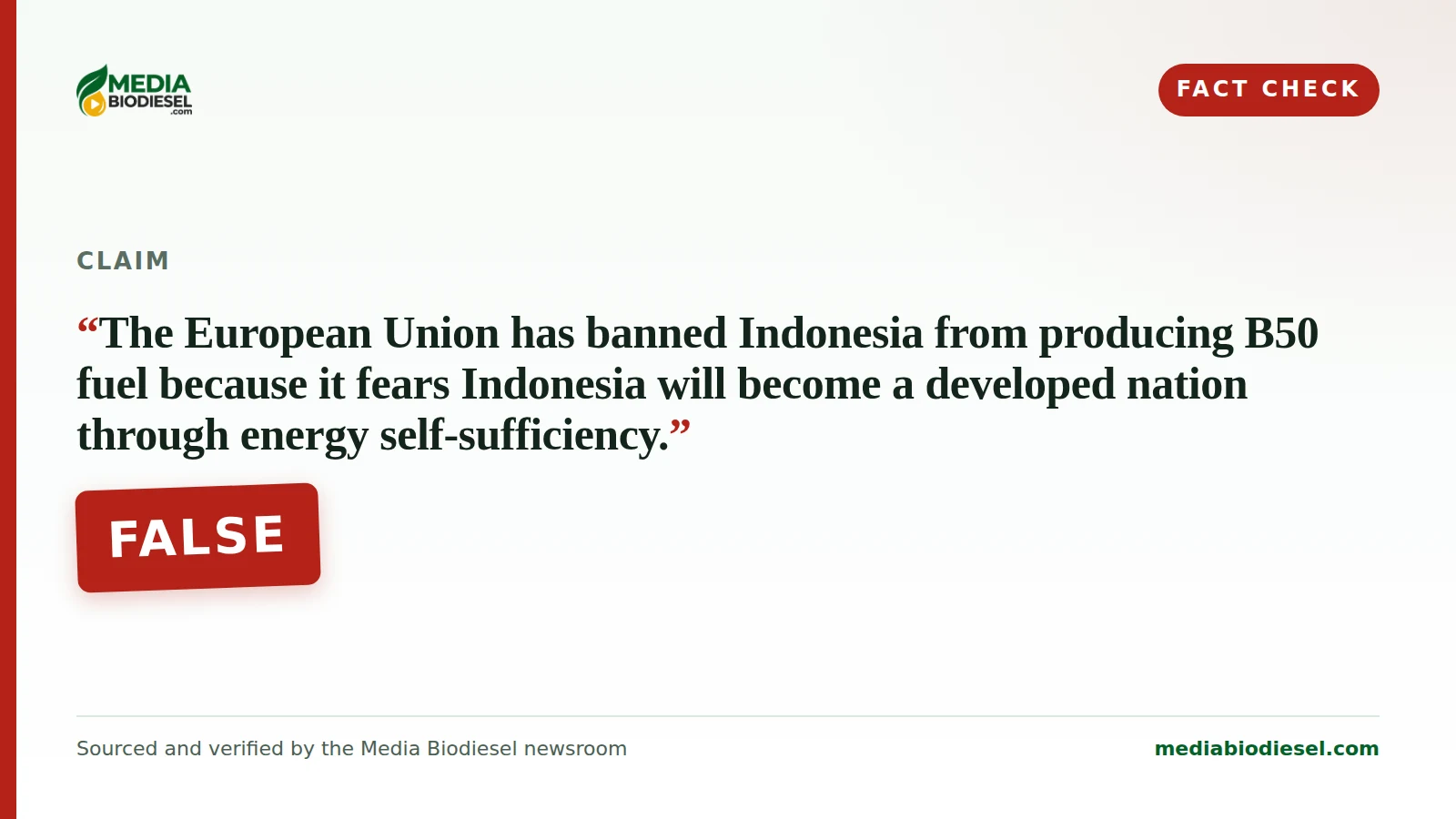
The claim that the European Union has banned Indonesia from producing B50 biodiesel is not supported by any evidence. There is no official EU statement prohibiting B50 production in Indonesia, and the B50 mandate has in fact been in force since 1 July 2026. What does exist are EU restrictions on the use of palm-based biodiesel in the European market and countervailing duties on Indonesian biodiesel, both of which Indonesia is contesting at the World Trade Organization (WTO).
Claim
The narrative spread through a YouTube video titled "UNI EROPA LARANG INDONESIA PRODUKSI BBM B50!! TAKUT RI JADI NEGARA MAJU! RI LAWAN SINGAPUR & EROPA!" ("EU bans Indonesia from producing B50 fuel!! Afraid Indonesia will become a developed country!"). According to a fact-check by the ANTARA news agency published on 8 July 2026, the video suggested the EU had banned B50 production out of fear that energy self-sufficiency would turn Indonesia into a developed nation.
Verdict: False
No EU decision, regulation or official statement banning Indonesia from producing B50 could be found. ANTARA noted that the video's content did not match its title: it mostly discussed the B50 rollout and its expected benefits, along with the palm oil trade dispute with Europe, without presenting any evidence of a ban. EU policy governs its own market and incentives; it does not regulate fuel production inside Indonesia.
The facts
- B50 is running without any European obstacle. ANTARA noted that B50, a blend of 50% palm-based biodiesel and 50% fossil diesel, took effect on 1 July 2026. Through ESDM Ministerial Decree 257.K/EK.01/MEM.E/2026, the Ministry of Energy and Mineral Resources (ESDM) allowed companies to sell remaining B40 stock until 30 September 2026.
- European restrictions target use, not Indonesian production. According to the WTO's summary of dispute DS593, Indonesia has since December 2019 challenged the EU's 7% maximum share and its cap and phase-out of biofuels with a high risk of indirect land-use change (high ILUC risk), a category that captures palm oil. These rules decide which biofuels can count towards the EU's renewable energy targets.
- Indonesia partly won at the WTO. A WTO panel report circulated on 10 January 2025 found that the EU had administered its high ILUC-risk cap and phase-out in a discriminatory way, including by failing to review its data in a timely manner and through flawed low-ILUC-risk criteria. But the panel also found that Indonesia had not shown the rules themselves were more trade-restrictive than necessary. The report was adopted on 24 February 2025, and the 12-month implementation period expired on 24 February 2026.
- The dispute is still open. On 6 March 2026 Indonesia asked the WTO for authorisation to suspend concessions (retaliate), arguing the EU had not complied. The EU objected on 19 March 2026, and the arbitration on that objection has been suspended since 29 June 2026 pending compliance proceedings.
- Biodiesel duties are also being contested. In dispute DS618, Indonesia challenged the countervailing duties the EU has applied since 2019 on Indonesian biodiesel. The WTO panel (report of 22 August 2025) found that the European Commission's determination of a threat of injury to EU biodiesel producers was inconsistent with WTO rules. The EU appealed on 26 September 2025, even though the WTO Appellate Body cannot hear appeals because it lacks members.
Context
The claim piggybacks on real friction. The EU does restrict palm biodiesel in its own market and imposes duties on Indonesian biodiesel, so some exports have lost favourable access. A fuller explanation of the ILUC concept is available in our explainer on ILUC.
Indonesia's government has, if anything, framed Europe's restrictions as a spur for its domestic market. As president-elect in August 2024, Prabowo Subianto called the European palm oil restrictions a "blessing in disguise" and said he would thank Europe for rejecting Indonesian palm oil, CNA Indonesia reported. In other words, far from being banned, B50 is Indonesia's policy answer for absorbing palm oil at home.
Readers are advised to check official sources, such as the WTO or ESDM websites, before sharing videos with provocative titles claiming a ban by another country or bloc.
Sources & references
- ANTARA, "Hoaks! Uni Eropa larang Indonesia produksi BBM B50" (8 July 2026) — https://www.antaranews.com/berita/5640380/hoaks-uni-eropa-larang-indonesia-produksi-bbm-b50
- WTO, "DS593: European Union — Certain Measures Concerning Palm Oil and Oil Palm Crop-Based Biofuels" (accessed 13 October 2026) — https://www.wto.org/english/tratop_e/dispu_e/cases_e/ds593_e.htm
- WTO, "DS618: European Union — Countervailing Duties on Imports of Biodiesel from Indonesia" (accessed 13 October 2026) — https://www.wto.org/english/tratop_e/dispu_e/cases_e/ds618_e.htm
- CNA Indonesia, "'Blessing in disguise': Prabowo optimistis boikot sawit Eropa justru genjot biodiesel nasional" (27 August 2024) — https://www.cna.id/indonesia/prabowo-bersyukur-uni-eropa-boikot-sawit-indonesia-biodiesel-b50-20691