How to Apply for BPDP Replanting (PSR) Funds in 2026: IDR 60 Million/ha, Up to 4 ha
Smallholder replanting grants are requested through farmer groups or cooperatives, not individually. Here are the requirements, documents and steps under Permentan 5/2025.
Contents (4 sections)
Smallholder oil palm growers can obtain a Smallholder Oil Palm Replanting (PSR) grant from the Plantation Fund Management Agency (BPDP) with a ceiling of IDR 60 million per hectare, for up to 4 hectares per person. Growers cannot apply on their own, however: proposals are submitted online by a growers' institution (a farmer group, a federation of farmer groups or a cooperative), either through the district/city plantation office or through a partnership with a plantation company. The legal basis is now Agriculture Ministerial Regulation (Permentan) No. 5 of 2025, which revoked Permentan 3/2022 and its amendment, Permentan 19/2023.
The IDR 60 million per hectare figure appears as the funding ceiling in the FAQ of BPDP's SMART-PSR portal and was cited by Lupi Hartono, BPDP's Director of Planning, Fund Collection and Fund Development, in February 2026, as quoted by Investortrust. Permentan 5/2025 itself sets no amount; plantation development funding follows a cost standard set by the Director General of Plantations.
Who is eligible for PSR?
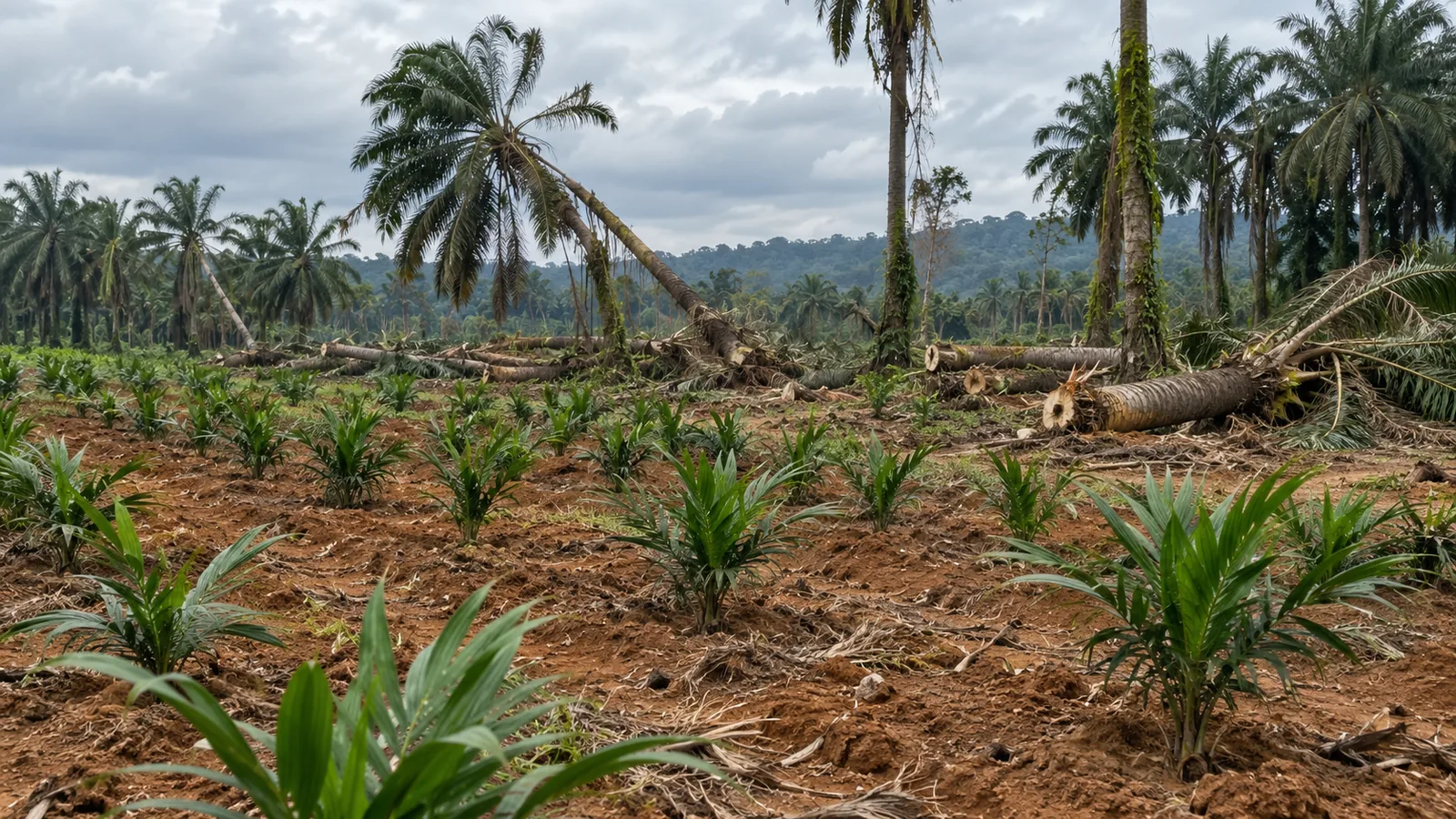
Under Permentan 5/2025, replanted land must belong to growers who are members of a growers' institution and who hold land legality documents. The institution must have at least 20 members or a contiguous area of at least 50 hectares, with no more than 10 kilometres between plots. Farmer groups and federations must also be registered in the agricultural extension information system.
The plantation must also meet replanting criteria: trees older than 25 years, productivity of no more than 10 tonnes of fresh fruit bunches (FFB) per hectare per year at an age of at least 7 years, and/or the use of non-certified (non-superior) seedlings. These criteria are attested by a statement from the growers' institution.
What to prepare
Article 41 of Permentan 5/2025 lists the proposal documents:
- A copy of each grower's ID card (KTP).
- The legal establishment of the farmer group, federation, cooperative or other institution, plus proof of registration in the agricultural extension information system (for farmer groups and federations).
- A freehold title certificate (SHM), another basis of land control, or a statement of physical control of the land; if the name on the land document differs from the grower's ID, a letter from the village head.
- Land status statements: not within a forest area (from the forestry ministry's unit) and not on a commercial plantation concession (HGU) (from the land office).
- A georeferenced plot map: at least 4 polygon coordinate points per grower, area, location, scale, legend and the maker's signature.
- A budget plan and work plan prepared by the institution.
- The institution's statement on tree age or productivity, the seedling purchase plan, who will carry out the replanting and the replanting technique.
Step-by-step: applying through the plantation office
- Attend outreach sessions and request a facilitator. District/city offices must assist with documents; the office head assigns a field facilitator for each area.
- Submit the proposal online through the institution to the head of the district/city office. If the online system is unavailable, offline submission is allowed.
- Document and field verification by the district/city office. If everything matches, a decree on prospective recipients and locations (CPCL) is issued; if not, the file is returned for correction.
- Technical recommendation. The CPCL decree goes to the provincial office and then to the Directorate General of Plantations, which issues a technical recommendation to BPDP's President Director.
- Approval and agreement. BPDP designates the recipients, followed by a three-party cooperation agreement. For Phase I of 2026, BPDP said 10 distributing banks were involved.
- Disbursement through SMART-PSR. The institution receives an account once the proposal is complete and the agreement is signed. Documents are checked by surveyor PT Sucofindo and by BPDP before transfer. The second-stage (50%) disbursement for the IDR 60 million/ha ceiling requires a physical progress report approved by the office head.
- Start replanting once the institution receives the funds, carried out by the institution itself, jointly with a partner, or by a partner plantation company.
Under the partnership route, an institution already working with a plantation company submits its proposal online directly to the Director General of Plantations, with a company statement vouching for the documents. Verification is carried out by a surveyor appointed by BPDP.
Why do proposals stall?
The regulation says incomplete files, or files that do not match field conditions, are returned to the applicant. According to Lupi Hartono, the main obstacle to PSR is land legality and permits, including plots inside forest areas, rather than a lack of funds. He said replanting is running at only about 40,000 hectares a year against a 120,000-hectare target. In January 2026, BPDP set a goal of accelerating PSR to 50,000 hectares over 2026 (see the Phase I 2026 PSR signing).
So check forest-area and HGU status before applying, make sure plot coordinates are accurate, and plan for co-funding: the regulation allows any shortfall to be covered by growers' savings, bank loans or other legitimate sources. For schedules and quotas in your area, ask your district/city plantation office directly.
Sources & references
- Kementerian Pertanian, "Peraturan Menteri Pertanian Nomor 05 Tahun 2025 tentang Pengembangan Sumber Daya Manusia, Penelitian dan Pengembangan, Peremajaan, serta Sarana dan Prasarana Perkebunan Kelapa Sawit" (6 February 2025; copy of the text) — https://jdih.pertanian.go.id/sources/files/Permentan_05-2025_sdh_TTE.pdf
- BPDP, "FAQ SMART PSR" (accessed 13 October 2026) — https://smart-psr.bpdp.or.id/faq
- BPDP, "Skema Pengusulan" (25 May 2023) — http://www.bpdp.or.id/skema-pengusulan-dana
- Investortrust, "Sawit Rakyat Jadi Fokus, BPDP Ungkap Kendala Struktural Peremajaan Nasional" (6 February 2026) — https://investortrust.id/national/93850/sawit-rakyat-jadi-fokus-bpdp-ungkap-kendala-struktural-peremajaan-nasional
- Investortrust, "BPDP Percepat Peremajaan Sawit 2026, Tahap I Jangkau 5.682 Ha" (29 January 2026) — https://investortrust.id/business/92958/bpdp-percepat-peremajaan-sawit-2026-tahap-i-jangkau-5682-ha