Pertamina NRE and SGN to Study Second-Generation Ethanol from Sugarcane Residues
A memorandum with SGN covers research on ethanol from sugarcane byproducts. Production scale and investment remain undecided pending technical and commercial reviews.
Contents (3 sections)
Jakarta — Pertamina New & Renewable Energy (Pertamina NRE) and PT Sinergi Gula Nusantara (SGN) have agreed to explore research into second-generation ethanol made from byproducts of sugarcane cultivation and processing. The memorandum was signed at a Jakarta forum on 27 October 2026 and reported on 3 November. The companies plan technical and commercial assessments; neither a plant capacity nor a target volume of ethanol production has been announced.
A research agreement, not an operating ethanol plant
ANTARA reported that the Pertamina NRE–SGN agreement concerns the possibility of developing second-generation, or 2G, ethanol from byproducts of sugarcane cultivation and processing. Bisnis.com independently reported the memorandum as part of the bioenergy cooperation highlighted by Pertamina NRE at the Danantara Technology Innovation & Investment Forum.
The scope of discussion includes technical feasibility, the availability of feedstock, technology, supply chains and project economics. Harsono Budi Santoso, Pertamina NRE’s director of strategic planning and business development, said technical and commercial reviews would determine whether the initiative was viable enough to pursue further. The memorandum does not say a processing technology has been selected or that fuel is ready for sale.
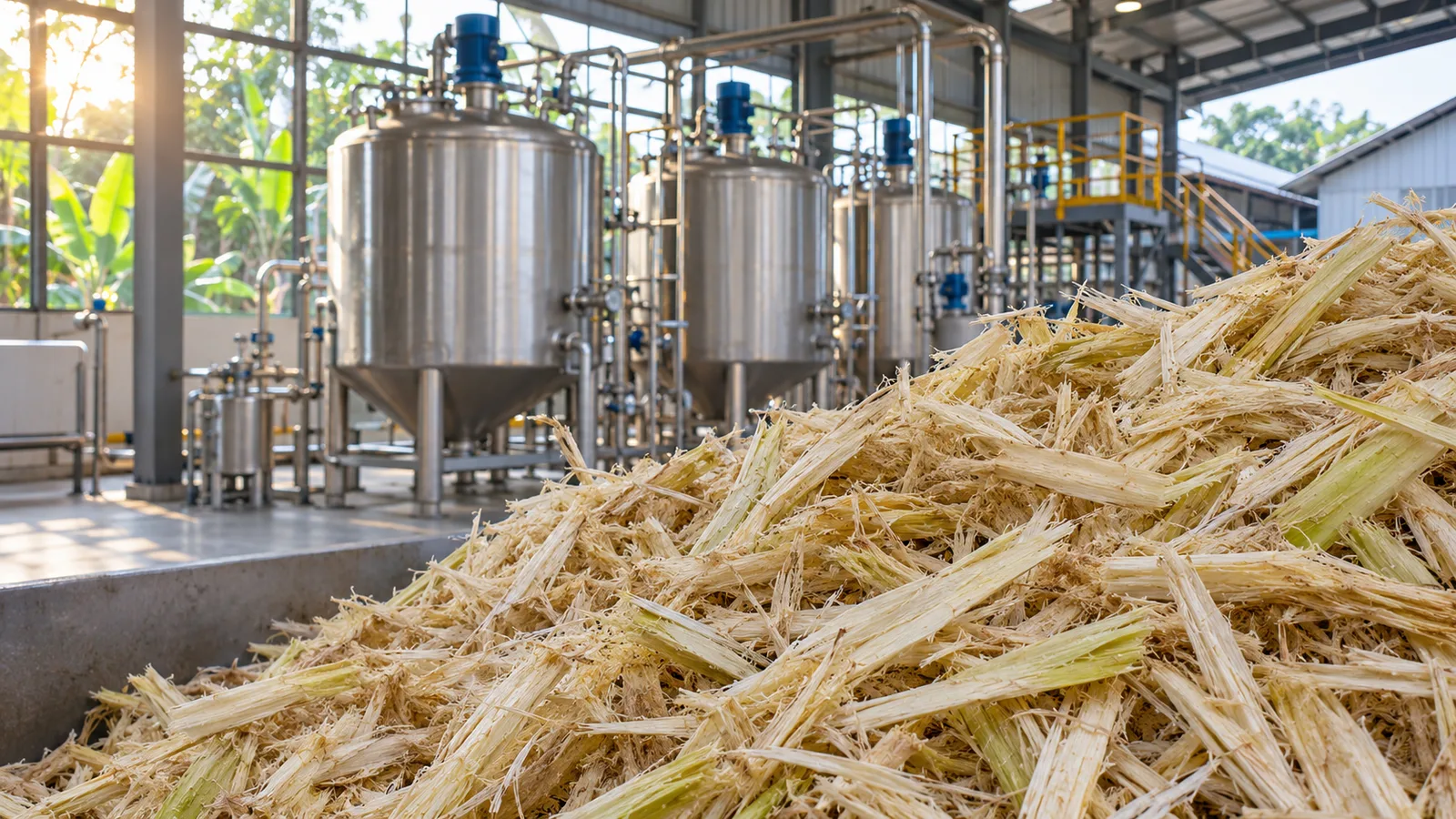
The second-generation description refers here to a proposed use of agricultural and processing byproducts. It is not evidence that an industrial-scale 2G ethanol facility has entered operation. The two reports give no precise sugarcane residue specification, plant location, conversion yield or investment figure for the SGN project. Without those details, it would be premature to estimate how much petrol demand its output might replace.
Two distinct routes in a wider bioenergy package
The 3 November reports also covered Pertamina NRE’s separate exploration of a fatty acid methyl ester (FAME) facility with PT Agrinas Palma Nusantara in Indragiri Hilir, Riau. ANTARA and Bisnis.com put that facility’s installed capacity at 600,000 tonnes per year. That figure belongs to a FAME facility, not to the proposed SGN ethanol research programme.
FAME is used in biodiesel blended with diesel fuel; ethanol is blended with petrol. The distinction matters because the discussion about running a FAME plant cannot demonstrate that SGN has started producing ethanol. Media Biodiesel has already covered the Agrinas facility proposal. The SGN memorandum is a separate angle within the same wider announcement, rather than newly commissioned biodiesel capacity.
The Agrinas arrangement also remains exploratory. According to the two reports, assessing the plant’s possible operation, maintenance, refurbishment and expansion would require technical, financial and legal review, as well as the necessary approvals. This context helps explain the stage reached by the SGN agreement: research and evaluation before any production decision.
What needs to be established before commercial scale
The immediate question for the SGN initiative is whether its byproduct feedstock can be supplied consistently and processed at a viable cost. The supply chain needs investigation because sugarcane residues arise across cultivation and processing operations rather than appearing as a guaranteed supply at a proposed plant. Feedstock, technology and economics are expressly among the areas the partners intend to assess.
Separately, the Energy and Mineral Resources Ministry (ESDM) reported on 3 November that the government was preparing a strategic plan covering E20 to E50 ethanol blends with the agriculture ministry. That provides policy context for domestic ethanol research. Neither announcement, however, assigns an E20 supply quota to the SGN initiative, so no contribution to a future blend can be inferred from this memorandum.
Readers should wait for study results, material specifications and financing and site decisions before describing this initiative as commercial ethanol supply. For now, the verified development is a research agreement and a defined set of feasibility questions, not an approved production forecast.
Sources & references
- ANTARA, "Pertamina NRE dan SGN-Agrinas perkuat pengembangan bioenergi" (3 November 2026) — https://www.antaranews.com/berita/5828311/pertamina-nre-dan-sgn-agrinas-perkuat-pengembangan-bioenergi
- Bisnis.com, "Pertamina NRE Jajaki Pengelolaan Pabrik Biodiesel Berkapasitas 600.000 Ton" (3 November 2026) — https://hijau.bisnis.com/read/20261103/652/2017966/pertamina-nre-jajaki-pengelolaan-pabrik-biodiesel-berkapasitas-600000-ton
- Ministry of Energy and Mineral Resources, "Perkuat Ketahanan Energi, Pemerintah Siapkan Storage Minyak hingga 60 Hari dan Bioetanol E20" (3 November 2026) — https://www.esdm.go.id/id/media-center/arsip-berita/perkuat-ketahanan-energi-pemerintah-siapkan-storage-minyak-hingga-60-hari-dan-bioetanol-e20
Stay on top of Indonesian biodiesel
The weekly newsletter: the week’s key news, prices and data in one email every Friday. Or follow our channels for daily prices.