Brazil Raises Biodiesel Mandate to B14 from 1 March 2024
Brazil introduced a B14 biodiesel blend on 1 March 2024 and scheduled a further increase to B15 in March 2025.
Contents (3 sections)
Brasília — Brazil raised the mandatory biodiesel content in diesel from B12 to B14 on 1 March 2024. The National Energy Policy Council (CNPE) decision accelerated the country’s previous blending timetable and reinforced biofuel policy as a tool to increase demand for agricultural feedstocks while reducing fossil diesel use.
CNPE Resolution No. 8 of 2023 set a minimum biodiesel content of 14% from March 2024 and 15% from March 2025. S&P Global Commodity Insights reported that the council approved the accelerated schedule in December 2023, giving the industry roughly two months to prepare for the B14 transition.
Moving directly from B12 to B14
The increase was significant for Brazil’s biodiesel market because the country had been operating a B12 blend. It also restored a clearer upward path after the mandate had changed during previous years.
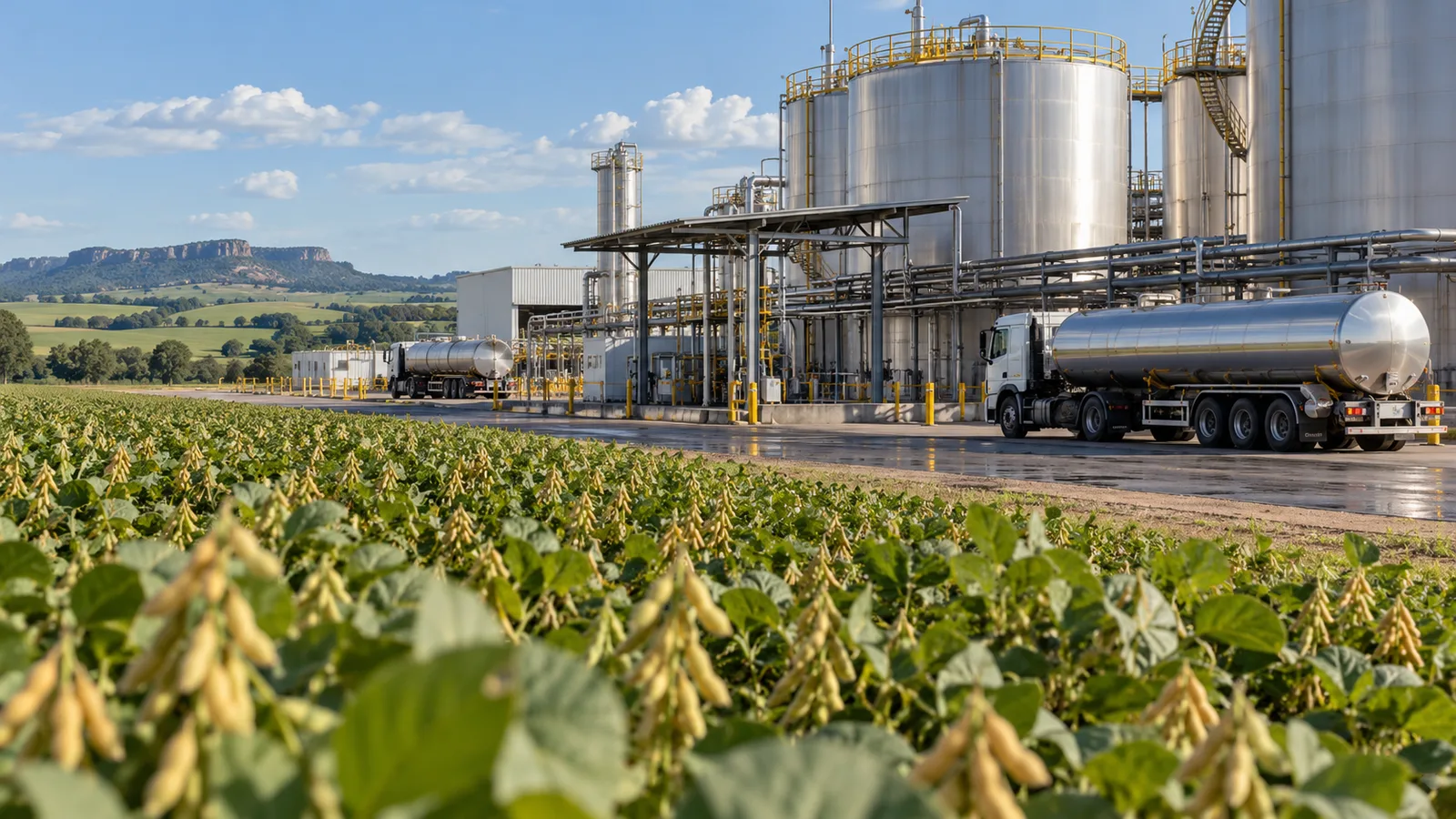
Brazil’s biodiesel chain is closely linked to soybean oil. A two-percentage-point increase therefore creates additional regulation-driven domestic demand for biodiesel and its feedstock. S&P Global noted that the CNPE decision drew immediate attention from the soybean oil market because mandatory blending determines how much material the fuel sector must absorb.
The policy did not stop at B14. The same resolution scheduled B15 for March 2025. That timetable gave biodiesel producers, vegetable-oil suppliers, distributors and transport companies a reference for planning capacity and feedstock procurement.
Brazil and Indonesia rely on different feedstocks
Brazil and Indonesia both use blending mandates to expand biodiesel demand, but their dominant feedstocks differ. Brazil relies mainly on soybean oil, while Indonesia’s programme is built around palm-based biodiesel. Indonesia had already introduced B35 on 1 February 2023, a higher blend than Brazil’s B14 when the new rule took effect.
Indonesia’s Ministry of Energy and Mineral Resources allocated 13.15 million kilolitres of biodiesel for 2023 to support B35. That volume illustrates how a higher blend must be accompanied by supply allocations, quality supervision, distribution planning and fuel-company readiness.
The blend percentages should not be treated as a simple ranking of policy success. Vehicle fleets, fuel specifications, production capacity, incentive structures and feedstock choices differ. Brazil’s decision nevertheless showed that mandatory biodiesel remained an important policy instrument for a major agricultural commodity producer.
What it means for Indonesia
For Indonesia, Brazil’s higher mandate matters mainly through the global vegetable-oil market. This is an editorial analysis: additional energy demand for soybean oil may affect price relationships among vegetable oils, including palm oil, although the impact is not automatic and will also depend on production, exports and national policies.
Brazil also provides a policy comparison. While Indonesia was implementing B35, Brazil chose a staged path to B14 and B15. Both approaches underline the value of a predictable timetable so industry can prepare feedstock, production capacity, logistics and quality controls. The comparison is relevant as Indonesia evaluates future blend increases and their effect on domestic palm-oil demand.
Readers can follow Indonesia’s blending history on the biodiesel mandate data page and review technical terms in the glossary.
Sources & references
- Conselho Nacional de Política Energética, “Resolução CNPE nº 8, de 8 de dezembro de 2023” (19 December 2023) — https://www.gov.br/mme/pt-br/assuntos/conselhos-e-comites/cnpe/resolucoes-do-cnpe/2023
- S&P Global Commodity Insights, “Brazil's biodiesel mandate to increase to 14% in March 2024” (19 December 2023) — https://www.spglobal.com/energy/en/news-research/latest-news/agriculture/121923-brazils-biodiesel-mandate-to-increase-to-14-in-march-2024
- Kementerian ESDM, “Penetapan Alokasi Biodiesel Tahun 2023 Sebesar 13,15 Juta Kiloliter” (30 December 2022) — https://www.esdm.go.id/id/media-center/arsip-berita/penetapan-alokasi-biodiesel-tahun-2023-sebesar-1315-juta-kiloliter
Stay on top of Indonesian biodiesel
The weekly newsletter: the week’s key news, prices and data in one email every Friday. Or follow our channels for daily prices.