Indonesia Starts B40 Road Test on 12 Diesel Vehicles
Indonesia began B40 and B30D10 road testing on 27 July 2022 to evaluate 12 diesel vehicles before any further policy decision.
Contents (3 sections)
Jakarta — Indonesia launched a B40 road test on 27 July 2022 to assess a 40% FAME-based biodiesel blend in 12 diesel vehicles. At the launch stage, the programme was still a technical evaluation; there were no final results and no mandatory B40 policy decision yet.
According to the Ministry of Energy and Mineral Resources (ESDM), the B40 blend under test consisted of 40% B100 or FAME and 60% B0. The government also prepared a B30D10 variant, made up of 30% B100, 10% D100 or HVO, and 60% B0. Energy Minister Arifin Tasrif described Indonesia as a pioneer in biodiesel use, but the statement was made in the context of a road-test launch, not the announcement of a new mandate.
Vehicles and blend scope
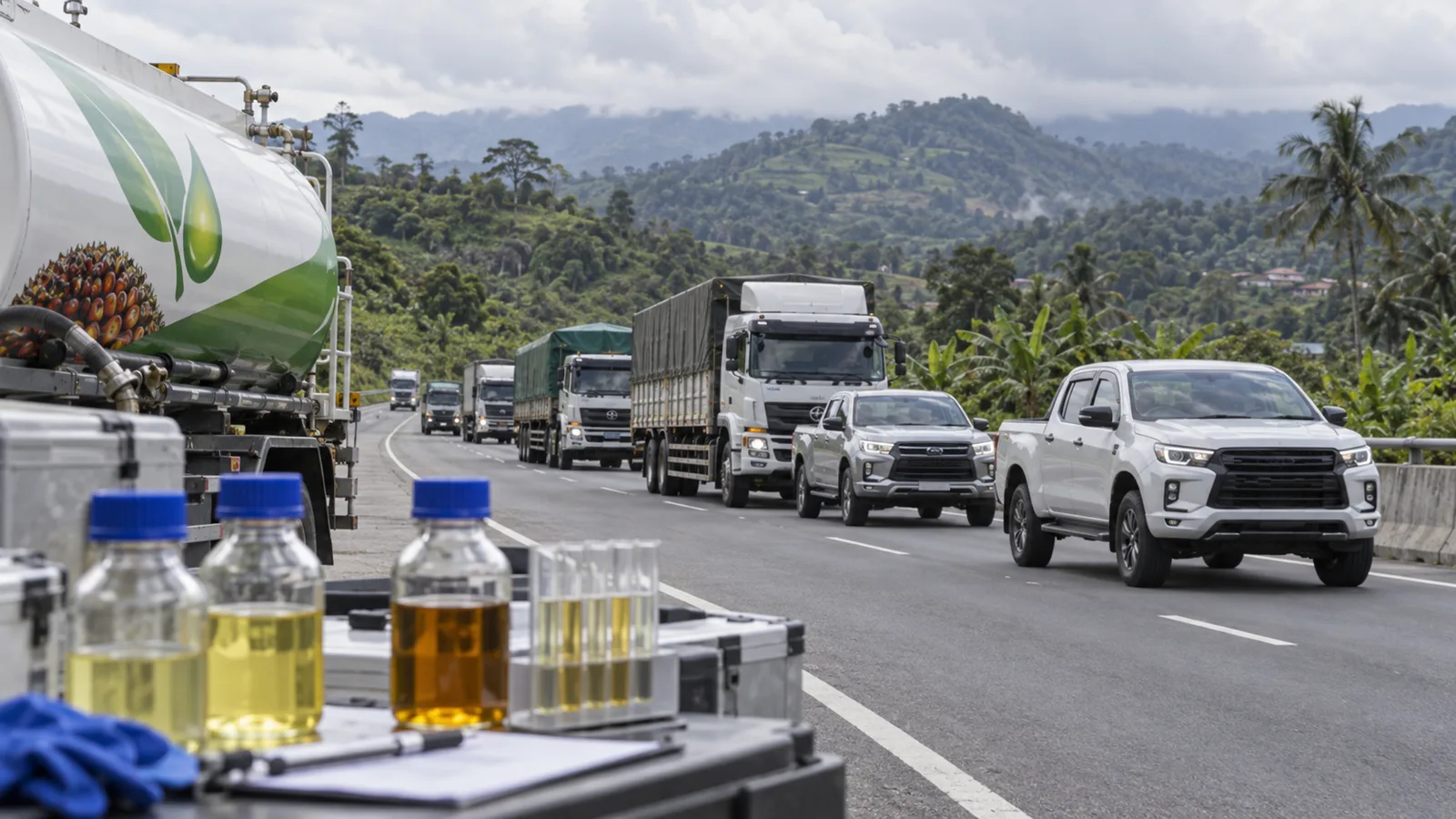
The road test involved 12 diesel vehicles. Six vehicles below 3.5 tonnes were assigned a 50,000-kilometre target. Six vehicles above 3.5 tonnes were assigned a 40,000-kilometre target. The route used was a return journey between Lembang and Cirebon, giving the test a mix of uphill, downhill and intercity driving conditions.
The scope matters because a higher FAME blend cannot be assessed from the fuel formula alone. Vehicle performance, fuel stability, lubricant condition, emissions and component durability all need to be examined under real operating conditions. For that reason, the launch of the road test did not mean B40 had immediately become a national obligation.
What the test measured
The Directorate General of Oil and Gas said BBPMGB LEMIGAS was directly supervising the process through to the targeted mileage. The assessment covered fuel consumption, fuel and lubricant quality, chassis dynamometer testing, component checks, stability, material compatibility, precipitation, torque, emissions and overhaul.
That list shows that the government was looking at both usability and quality control. For vehicle users and fleet operators, practical questions such as filters, lubricant behaviour, engine output and emissions had to be answered through test data rather than assumptions.
Coordination and limits of the record
The programme was coordinated by the Directorate General of New, Renewable Energy and Energy Conservation (EBTKE), with LEMIGAS and related institutions involved. The launch took place while Indonesia was already implementing B30, placing B40 as a further testing stage rather than an immediate regulatory step.
As of 28 July 2022, the available record did not include final results on fuel consumption, emissions, torque, component condition or a recommendation for a mandate. The safe conclusion is therefore narrow: Indonesia had started B40 and B30D10 road testing, while the next policy decision still depended on evaluation results.
Sources & references
- Kementerian ESDM, "Peluncuran Uji Jalan B40, Menteri ESDM: Indonesia Pionir Pemanfaatan Biodiesel" (27 July 2022) — https://www.esdm.go.id/en/media-center/news-archives/peluncuran-uji-jalan-b40-menteri-esdm-indonesia-pionir-pemanfaatan-biodiesel
- Ditjen Migas ESDM, "Peluncuran Uji Jalan B40 pada Kendaraan Bermesin Diesel, BBPMGB LEMIGAS Kawal Langsung Proses Berlangsungnya Uji Jalan Hingga 50.000 KM" (28 July 2022) — https://www.migas.esdm.go.id/post/peluncuran-uji-jalan-b40-pada-kendaraan-bermesin-diesel-bbpmgb-lemigas-kawal-langsung-proses-berlangsungnya-uji-jalan-hingga-50-000-km
- detikFinance, "RI Resmi Ngetes Bensin Campur 40% Sawit" (27 July 2022) — https://finance.detik.com/energi/d-6201571/ri-resmi-ngetes-bensin-campur-40-sawit
Stay on top of Indonesian biodiesel
The weekly newsletter: the week’s key news, prices and data in one email every Friday. Or follow our channels for daily prices.