Auditing B100 Feedstock: Critical Land Is Not Automatically Available for Energy Crops
An opinion column raises questions about peat in future B100 feedstock. Rehabilitation and peat-protection rules require parcel-level checks before supply claims can be tested.
Contents (3 sections)
Jakarta — An opinion column by Dr.-phil. Ir. Arinafril in Kompas.com on 22 October 2026 asks whether degraded land proposed for a future B100 biofuel supply might include peatland in need of restoration. The government’s own rules show why the distinction matters: a “critical land” designation is not a conversion permit. The peatland’s legally designated function, rehabilitation plan, land rights and fire history must be checked for the same parcel before it could be counted as a candidate energy-crop source. B50 is in operation; the sources reviewed here do not establish a B100 fuel mandate.
Arinafril’s text is a personal opinion column, not the Kompas.com newsroom’s position. It raises a question, but does not demonstrate that a particular parcel has been converted. Our earlier report covered presidential envoy Hashim Djojohadikusumo’s statement on degraded land, while another article examined a proposed ecological limit for palm cultivation. This article instead asks what spatial and supply-chain records would make a feedstock claim independently testable.
Critical land is not a planting licence
Environment and Forestry Ministerial Regulation No. 23/2021 defines critical land as land inside or outside forest areas whose function as a productive resource and as a regulator of watershed water flows has declined. The regulation governs forest and land rehabilitation, including in peat ecosystems. Where rehabilitation plans are not yet prepared, it calls for an assessment of critical-land and other thematic maps together with a field check. The activity design records the site, area and social, economic and cultural conditions. In other words, the map informs restoration decisions; it is not a list of plots automatically available for oil palm.
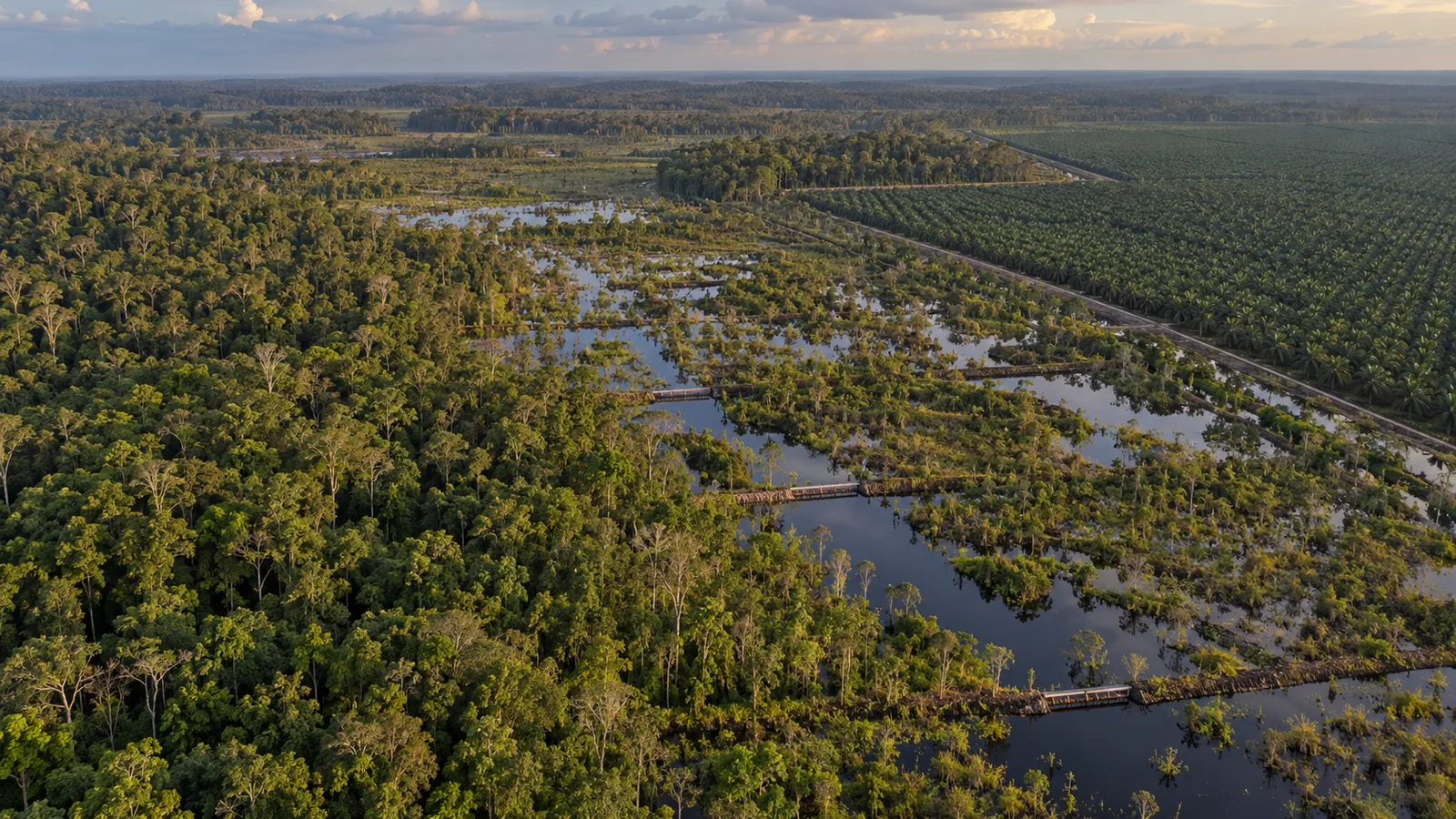
A parcel may appear on a critical-land map while also lying within a peat hydrological unit, or KHG. Testing that overlap requires matching parcel boundaries, map dates and scales, and field observations. We have not obtained parcel-level boundaries for the area cited in the public debate, so this article makes no estimate of its overlap with peatland, concessions or restoration obligations.
Peat functions and the duty to restore
Government Regulation No. 71/2014, as amended by No. 57/2016, distinguishes protected and cultivation functions of peat ecosystems. The protected area must cover at least 30% of a KHG, beginning at one or more peat-dome summits; deep peat, protected species or designated conservation areas can require further protection. The national peat-function map has a minimum scale of 1:250,000, while provincial and district/city maps have a minimum scale of 1:50,000. A cultivation classification is not a blanket licence to drain or burn peat.
The regulation prohibits drainage that dries peat and peat burning, and requires businesses to restore damage caused by their use of peat ecosystems. Cultivation-function peat can even be redesignated as protected where ecological urgency demands prevention or restoration; the regulation’s explanation identifies burned and damaged peat as an example. A previous fire therefore does not itself turn peat into vacant land for an energy crop. The Environment and Forestry Ministry also describes restoration through rewetting, revegetation and livelihood revitalisation planned across the hydrological unit rather than for an isolated plot.
From parcel boundaries to a fuel shipment
To test a claim that prospective B100 feedstock comes from degraded land, our proposed audit would first release parcel boundaries, the year and method of critical-land classification, and overlays with KHG/peat-function, land-cover and rehabilitation maps. It would then examine permits, community rights, fire history, peat depth, drainage and field-verification records. Finally, the qualifying farm plots would need to be connected to fresh fruit bunch purchase records, crude palm oil processing, biodiesel production and deliveries to blenders. This is an editorial audit framework, not a claim that the government has deployed such a tracing system.
Oil and Gas Directorate-General Decision 75.K/MG.06/DJM/2026 sets specifications for B50 diesel and refers to B100 biodiesel quality as a blending component checked before it is mixed with fossil diesel. The term B100 in that technical standard does not announce a mandate to sell fuel consisting entirely of biodiesel. Fuel-quality testing at delivery establishes composition, not the geographic origin of the palm fruit. Without links from farm records to mill and fuel volumes, the claim that each litre is sourced from damaged land rather than primary forest cannot yet be independently audited.
Sources & references
- Kompas.com, "Biofuel B100 di Atas Lahan Terluka" (Arinafril’s personal opinion column, 22 October 2026) — https://nasional.kompas.com/read/2026/10/22/12420081/biofuel-b100-di-atas-lahan-terluka?page=all
- JDIH BPK, "Permen LHK Nomor 23 Tahun 2021 tentang Pelaksanaan Rehabilitasi Hutan dan Lahan" — https://peraturan.bpk.go.id/Download/288634/Permen%20LHK%20Nomor%2023%20Tahun%202021.pdf
- JDIH BPK, "PP Nomor 57 Tahun 2016 tentang Perubahan PP 71/2014" — https://peraturan.bpk.go.id/Download/27762/PP%20Nomor%2057%20Tahun%202016.pdf
- KLHK, "Upaya Menyeluruh dan Dukungan Semua Pihak, Kunci Keberhasilan Pemulihan Lahan Gambut" (19 June 2024) — https://www.menlhk.go.id/news/wamen-lhk-upaya-menyeluruh-dan-dukungan-semua-pihak-kunci-keberhasilan-pemulihan-lahan-gambut/
- Ministry of Energy and Mineral Resources, "Oil and Gas Directorate-General Decision 75.K/MG.06/DJM/2026: B50 Diesel Specifications" (25 June 2026) — https://migas.esdm.go.id/cms/uploads/perpustakaan/buku-referensi/09e3e975615548a62972357133b351d4.pdf
Stay on top of Indonesian biodiesel
The weekly newsletter: the week’s key news, prices and data in one email every Friday. Or follow our channels for daily prices.