Prabowo Pushes B50 and E50; Ending Fuel Imports Remains Conditional
Prabowo outlined a path from E10 to E50 around 2030. B50 is already in force, while an end to all fuel imports has not been demonstrated.
Contents (3 sections)
Jakarta — President Prabowo Subianto said on Wednesday, 21 October 2026, that Indonesia should advance its B50 biodiesel programme and develop an E50 bioethanol blend to reduce dependence on imported petroleum fuels. Bisnis.com reported his expectation that E10 could be reached this year, E20 about two years later and E50 another two years after that. His suggestion that Indonesia might eventually stop importing fuel was conditional, not a verified outcome.
E50 timetable is an expectation
At a cabinet meeting, Prabowo said Indonesia had reached B50 and would work towards E50, according to Bisnis.com. His projected stages point to E10 in 2026, E20 around 2028 and E50 around 2030 if implementation goes as hoped. The qualifiers in his remarks matter. These are not binding dates or proof that domestic ethanol supply, blending facilities and distribution are already ready for such levels.
The Ministry of Energy and Mineral Resources (ESDM) said on 17 September that the president had directed officials to draw up an E50 programme, applying lessons from B50. Its statement described preparations, not the launch of an E50 mandate. The October remarks should thus be reported as a policy ambition rather than a fuel already sold under a nationwide E50 requirement.
B50 is at a different stage. ESDM said the 50% biodiesel blend began distribution on 1 July and the mandatory programme was launched on 9 July 2026. Its mid-September update said B50 reached 6,050 of 6,412 filling stations, while some terminals were still transitioning. A call to accelerate B50 in October therefore concerns an existing programme's implementation, not the start of a new mandate.
Ending imports is not established
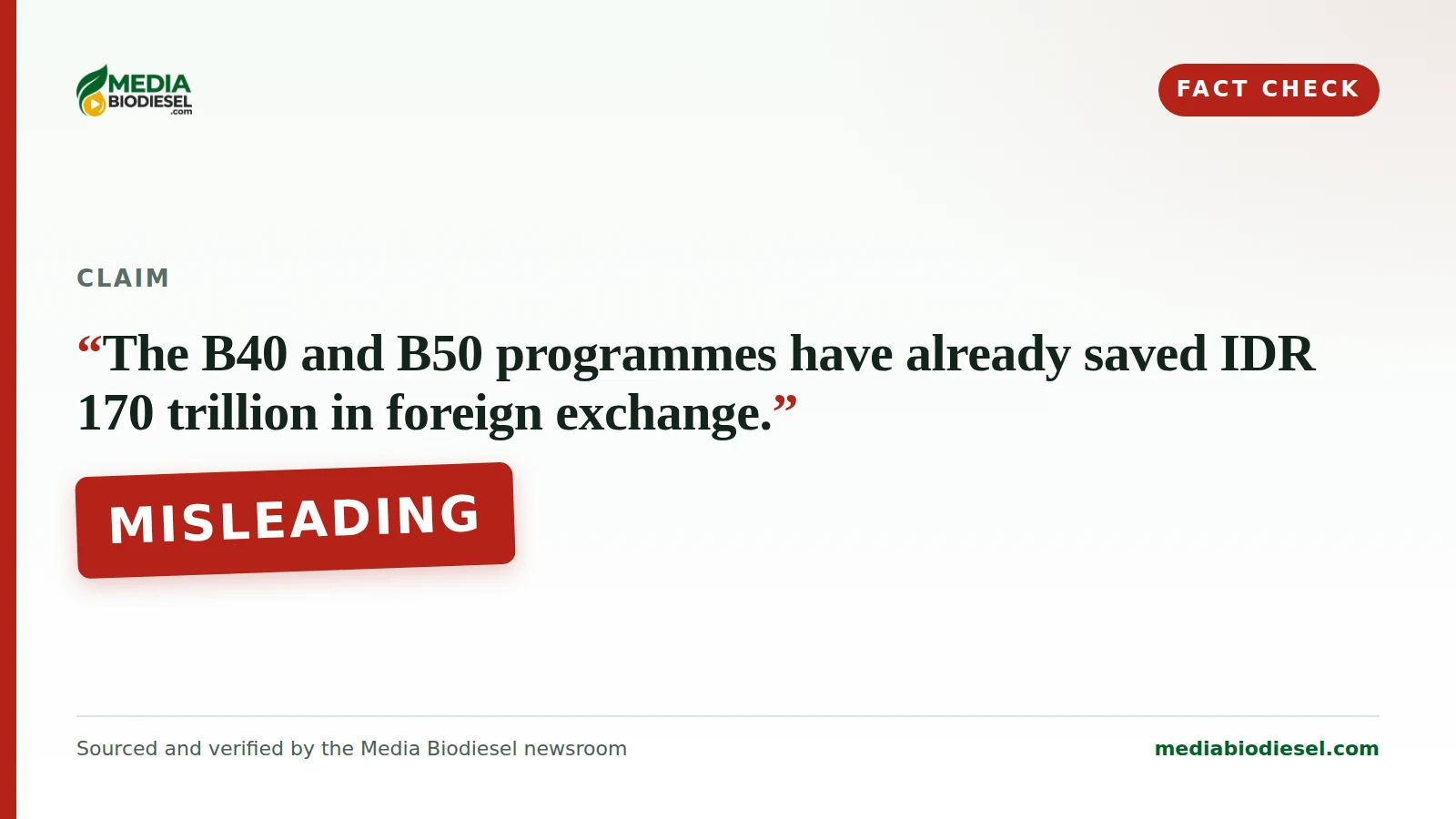
Bisnis.com quoted Prabowo as expressing the hope that, when B50 and E50 are in place, Indonesia would no longer need to import fuel. That is a conditional claim. ESDM's September statement described B50 as reducing dependence on imported CN48 diesel and E50 as a plan in preparation. A reduction in imports of one diesel product is not evidence that all petroleum fuel imports, including petrol and other products, have ended.
In explaining E50 preparations, ESDM put annual national diesel consumption at about 39 million kilolitres and petrol consumption at roughly 39–40 million kilolitres. These figures show the scale of demand but not current import volumes, domestic ethanol capacity or the balance of fuels after future blending changes. Neither report supplies an independently verified product-by-product balance demonstrating when all fuel imports could fall to zero.
By definition, B50 and E50 designate 50% biofuel blends; the labels alone do not guarantee that the remaining fossil-fuel component is domestically produced. Feedstock supply, fuel quality, refinery and terminal capacity, and actual distribution also affect outcomes. ESDM listed exploration and work on older oil wells alongside biofuel policy as additional measures for domestic supply. The import claim should not be inferred from a blend percentage alone.
What to watch next
The relevant tests are formal ethanol blending rules, actual domestic production and distribution, B50 delivery, and import data broken down by product. Until those are available, the president's statement is a policy direction and projection, not proof of import cessation. Readers can consult the biodiesel mandate timeline and the B50 guide for the existing programme.
Sources & references
- Bisnis.com, "Prabowo Minta Program B50 dan E50 Dikebut: RI Bisa Setop Impor BBM" (21 October 2026) — https://ekonomi.bisnis.com/read/20261021/44/2014543/prabowo-minta-program-b50-dan-e50-dikebut-ri-bisa-setop-impor-bbm
- ESDM, "Usai B50, Pemerintah Siapkan E50 Langkah Baru Kurangi Ketergantungan BBM Impor" (17 September 2026) — https://www.esdm.go.id/id/media-center/arsip-berita/usai-b50-pemerintah-siapkan-e50-langkah-baru-kurangi-ketergantungan-bbm-impor
- ESDM, "Kawal Implementasi B50, Kementerian ESDM Perkuat Uji Teknis dan Dialog dengan Industri Otomotif" (15 September 2026) — https://www.esdm.go.id/id/media-center/arsip-berita/kawal-implementasi-b50-kementerian-esdm-perkuat-uji-teknis-dan-dialog-dengan-industri-otomotif
Stay on top of Indonesian biodiesel
The weekly newsletter: the week’s key news, prices and data in one email every Friday. Or follow our channels for daily prices.