HVO Catalysts: Hydrotreated Vegetable Oil Catalysts Explained
How hydrotreated vegetable oil catalysts work: reaction pathways, sulfided NiMo/CoMo and Pt-zeolite catalysts, what deactivates them, the main licensors and Indonesia's Merah Putih catalyst.
Contents (7 sections)
- What does a catalyst do in vegetable oil hydrotreating?
- Types of HVO catalyst
- Why do NiMo and CoMo catalysts need sulfiding?
- What deactivates HVO catalysts, and why pretreatment matters
- Commercial HVO technologies and their licensors
- The Indonesian angle: the Merah Putih catalyst and BRIN research
- Is HVO the same as distilled FAME?
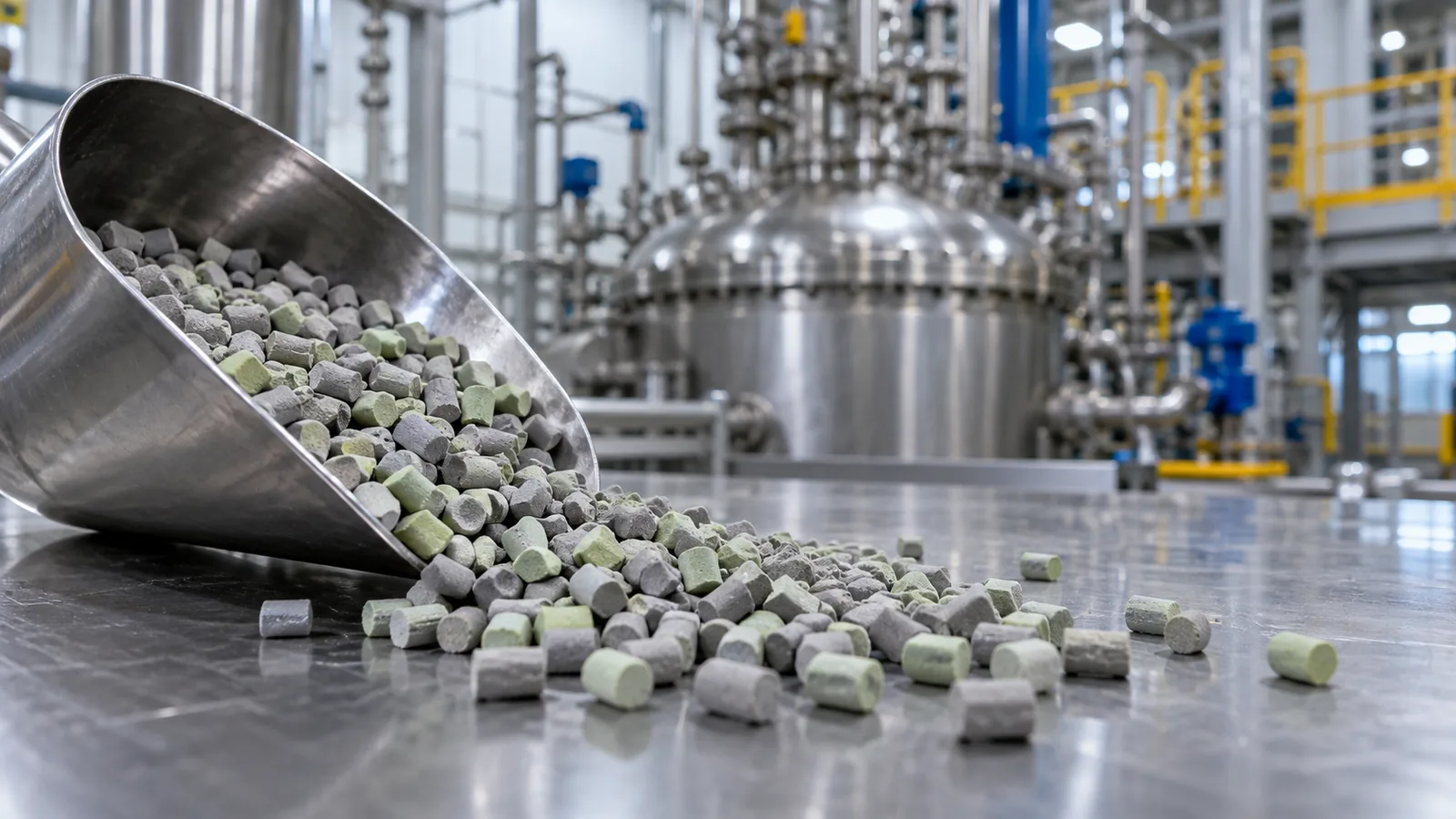
An HVO catalyst is a solid catalyst that makes vegetable oil react with hydrogen, stripping out the oxygen and leaving diesel-like hydrocarbons: HVO (hydrotreated vegetable oil). Commercial plants usually work in two steps. First, a hydrotreating catalyst, typically sulfided NiMo or CoMo on alumina, removes the oxygen. Then a bifunctional catalyst, for example platinum on a zeolite or SAPO support, isomerises the product so it does not wax up in the cold. In Indonesia, ITB and Pertamina have developed a hydrotreating catalyst for palm oil called the Merah Putih catalyst.
What does a catalyst do in vegetable oil hydrotreating?
Vegetable oil is made of triglycerides: three fatty-acid chains attached to a glycerol backbone. A review by Di Vito Nolfi and colleagues in IJERPH (2021) sets out the reaction sequence. Hydrogen first saturates the double bonds. The fatty acids are then released one by one, and the glycerol backbone ends up as propane. Finally, the oxygen is removed from the fatty acids. Without a catalyst, these reactions would need far more energy.
A 2023 review in RSC Advances by a team from Institut Teknologi Sepuluh Nopember (ITS) in Indonesia says the process generally runs at 200–400 °C and 1–10 MPa over supported metal catalysts. Neste describes its NEXBTL technology the same way. Impurities are removed before catalytic processing, hydrodeoxygenation then uses hydrogen to remove the oxygen, and isomerisation tunes the product's properties. For the whole process, feedstocks and uses, see what is HVO (hydrotreated vegetable oil).
Hydrodeoxygenation vs decarboxylation vs decarbonylation
Oxygen can leave by three routes. The catalyst, the temperature and the hydrogen pressure decide which one dominates.
- Hydrodeoxygenation (HDO): oxygen leaves as water. The alkane keeps the same carbon number as the original fatty acid, for example C18 from stearic acid. This route makes the best use of the carbon but consumes the most hydrogen. The reaction is exothermic, so lower temperatures favour it.
- Decarboxylation (DCO2): oxygen leaves as CO2 and the alkane loses one carbon (C17). No hydrogen is needed to remove the oxygen, but one carbon is lost as a greenhouse gas.
- Decarbonylation (DCO): oxygen leaves as CO and water, and the alkane is again one carbon shorter.
The ITS review notes that industrial plants, including Neste's refinery in Porvoo, Finland, mostly follow the HDO route. On sulfided catalysts, nickel tends to favour DCO/DCO2 and molybdenum favours HDO. A NiMo combination gives roughly equal amounts of both, according to a study by Kubička cited by Di Vito Nolfi.
Types of HVO catalyst
The exact formulations of commercial catalysts are trade secrets. The scientific literature and licensors' publications do, however, describe the main families below.
| Catalyst type | Role | Active metals | Support | Process step | Notes |
|---|---|---|---|---|---|
| Guard (trap) catalyst | Catches phosphorus and metals before the main catalyst | Varies; some are also active for HDO | Large-pore material | Guard section of the hydrotreating reactor | Commercial example: Topsoe TK-3000 PhosTrap |
| Sulfided NiMo / CoMo (also NiW) | Hydrodeoxygenation, saturation, sulfur removal | Mo or W promoted with Ni or Co | γ-alumina (Al2O3) | Main hydrotreating reactor | Derived from refinery desulfurisation catalysts; must be kept sulfided |
| Bifunctional noble metal | Hydroisomerisation of n-paraffins into branched paraffins | Pt (sometimes Pd) | Acidic zeolite/SAPO, e.g. SAPO-11, ZSM-22 | Second step, after deoxygenation | Improves cold-flow properties; sensitive to nitrogen slip |
| Noble metal for deoxygenation | Deoxygenation, mainly DCO/DCO2 | Pd, Pt | Activated carbon, alumina, silica | Research scale | Very active but expensive and prone to water poisoning |
| Sulfur-free nickel | Deoxygenation without adding sulfur | Reduced Ni, Ni phosphide, carbides/nitrides, Ni–Sn | Alumina, silica, activated carbon, zeolites | Research scale | Avoids sulfur contamination; Indonesia's BRIN is testing Ni–Sn |
In a comparison of sulfided catalysts on rapeseed oil summarised by Di Vito Nolfi, NiMo/γ-Al2O3 was the most active. Among noble metals, a study by Snåre cited in the same review found Pd and Pt the most active, followed by Ni. Other studies show that nickel catalysts with a high enough metal loading can match noble metals.
Isomerisation is needed because the straight n-alkanes from deoxygenation have poor cold-flow properties. Di Vito Nolfi says hydroisomerisation runs at higher temperatures than deoxygenation, over catalysts such as Pt/SAPO-11, and the product keeps a similar cetane value. A 2020 review by Yeletsky and colleagues in Fuel explains that these catalysts are bifunctional. The metal handles hydrogenation and dehydrogenation, while the acidic support rearranges the carbon chain.
Why do NiMo and CoMo catalysts need sulfiding?
NiMo and CoMo are, at heart, petroleum desulfurisation catalysts, and their active form is a metal sulfide. Vegetable oil contains almost no sulfur, yet these catalysts only work in sulfided form. As a result, sulfur gradually leaches from the catalyst surface and activity drops quickly.
Di Vito Nolfi reports that adding a sulfiding agent to the feed, such as H2S or CS2, limits this deactivation. In a study by Şenol, H2S worked better than CS2. The trade-off is that selectivity shifts from mainly HDO to a mix of HDO and DCO/DCO2, and sulfur can end up in the product. That drawback is why researchers are working on sulfur-free catalysts such as reduced nickel, phosphides and carbides.
What deactivates HVO catalysts, and why pretreatment matters
- Phosphorus. Topsoe calls phosphorus the most significant poison in renewable feeds. Phosphorus from phospholipids binds to the surface of catalyst particles and forms a glass-like material. This glues the particles together and fills the gaps between them, so pressure drop across the reactor builds quickly. In severe cases, the reactor has to be shut down and the catalyst replaced.
- Metals. Topsoe designs its guard beds to catch P, Na, K, Ca, Mg, Fe, Ni and V from the feed. The company says its TK-3000 PhosTrap picks up four to six times as much phosphorus by volume as its previous guard. That figure is the manufacturer's claim.
- Coke and sintering. Both reviews note that excessive temperatures promote aromatisation and polymerisation, which leave coke in the catalyst pores. Metal particles can also sinter (clump together).
- Water. The HDO route produces water, which can reduce catalyst activity. The ITS review also notes that noble metals are prone to water poisoning.
- Nitrogen. Ketjen reports that residue and waste feeds can carry high concentrations of nitrogen compounds. Any nitrogen that gets past the HDO stage threatens the isomerisation catalyst.
That is why feedstock is cleaned before it reaches the reactor. Neste says renewable raw materials contain impurities that must be removed before catalytic processing. Topsoe writes that pretreatment can reduce phosphorus, but some always reaches the reactor, so guard layers are still needed.
Commercial HVO technologies and their licensors
- Neste NEXBTL: Neste's own technology, patented more than 25 years ago, with its first unit at Porvoo. The process runs from pretreatment through hydrodeoxygenation to isomerisation and makes renewable diesel and SAF.
- Honeywell UOP Ecofining: developed jointly with Eni. Honeywell says it has been used to make SAF commercially since 2016. In January 2021 Honeywell reported 20 licensed units in nine countries running 12 types of feedstock. Its single-stage version uses a combination of catalysts in one unit to remove oxygenates and then isomerise the product, and Honeywell says the diesel has a cetane value of 80.
- Topsoe HydroFlex: converts fats, oils and greases into drop-in renewable diesel and jet fuel. According to Topsoe in July 2023, HF Sinclair runs three HydroFlex-based renewable diesel facilities in Wyoming and New Mexico.
- Axens Vegan: a two-step process of hydrotreatment followed by hydroisomerisation over a bifunctional catalyst. Axens says it can process up to 100% lipids into SAF or renewable diesel. Its contract with Haike Chemicals in China (August 2023) was the technology's first reference in Asia.
All four licensors supply the catalysts for their own technologies but do not disclose the exact formulations.
The Indonesian angle: the Merah Putih catalyst and BRIN research
Indonesia's hydrotreating catalyst for palm oil was developed by the Chemical Reaction Engineering and Catalysis Laboratory (TRKK) at Institut Teknologi Bandung (ITB) with Pertamina's research unit. According to ITB, about 12 tonnes of the second-generation catalyst, trademarked PK 220 HBD, were loaded in February 2019 into the Distillate Hydrotreating (DHDT) unit at Pertamina's Dumai refinery, which has a capacity of 12,600 barrels per day. From March 2019 the unit co-processed 10–12% palm oil with fossil gas oil. ITB also says more than 150 tonnes of the catalyst had been made since 2011 for 8 reactors at five Pertamina refineries.
The Ministry of Energy and Mineral Resources (ESDM) says Pertamina injected refined, bleached and deodorised palm oil (RBDPO) into DHDT units using the Merah Putih catalyst. In July 2020 the Dumai refinery produced D100 renewable diesel with a cetane number of up to 79. The catalyst is now made by PT Katalis Sinergi Indonesia in Cikampek, which has a capacity of 800 tonnes a year and 13 catalyst products. Deputy Investment and Downstreaming Minister Todotua Pasaribu, quoted by ANTARA, said raw materials such as cobalt, nickel, zeolite, molybdenum and zinc are available in Indonesia. The full history is in our Merah Putih catalyst explainer. The public sources we reviewed do not give the metal composition of the Merah Putih catalyst.
On the sulfur-free side, the National Research and Innovation Agency (BRIN) is developing a nickel–tin catalyst on activated carbon as an alternative to noble-metal catalysts, ANTARA reported on 23 October 2026. The results are still at laboratory scale.
Is HVO the same as distilled FAME?
No. Distilling FAME (the biodiesel used in B40/B50) only purifies the methyl esters made by transesterifying oil with methanol, so the molecules still contain oxygen. HVO is an oxygen-free paraffin made by reaction with hydrogen over a catalyst. A table cited by Di Vito Nolfi gives a cetane number of 70–90 for green diesel, against 50–65 for biodiesel and 40 for fossil diesel. For a fuller comparison, see Biodiesel vs HVO vs SAF.
Sources & references
- Di Vito Nolfi, Gallucci & Rossi, "Green Diesel Production by Catalytic Hydrodeoxygenation of Vegetables Oils", Int. J. Environ. Res. Public Health 18(24):13041 (December 2021) — https://pmc.ncbi.nlm.nih.gov/articles/PMC8700882/
- Rahmawati et al. (ITS), "Selectivity of reaction pathways for green diesel production towards biojet fuel applications", RSC Advances 13 (May 2023) — https://pmc.ncbi.nlm.nih.gov/articles/PMC10157453/
- Yeletsky et al., "Recent advances in one-stage conversion of lipid-based biomass-derived oils into fuel components – aromatics and isomerized alkanes", Fuel (2020) — https://pmc.ncbi.nlm.nih.gov/articles/PMC7313509/
- Neste, "NEXBTL technology" (accessed 29 October 2026) — https://www.neste.com/about-neste/innovation/nexbtl-technology
- Honeywell UOP, "Ecofining" (accessed 29 October 2026) — https://uop.honeywell.com/en/industry-solutions/renewable-fuels/ecofining
- Energy Global, "Honeywell introduces new renewable diesel technology" (13 January 2021) — https://www.energyglobal.com/other-renewables/13012021/honeywell-introduces-new-renewable-diesel-technology
- Topsoe, "Topsoe technology supports HF Sinclair's renewable fuels production in the United States" (3 July 2023) — https://www.topsoe.com/news/topsoe-technology-supports-hf-sinclairs-renewable-fuels-production-in-the-united-states
- Axens, "Axens will provide Vegan® technology to Haike Chemicals for its sustainable aviation fuel (SAF) project in China" (2 August 2023) — https://www.axens.net/resources-events/news/pr-axens-will-provide-veganr-technology-haike-chemicals-its-sustainable
- PTQ/ERTC (Topsoe), "Renewing the fight against phosphorus" (December 2021) — https://digitalrefining.com/article/1002687/renewing-the-fight-against-phosphorus-ert
- Decarbonisation Technology (Topsoe), "Catalyst innovations for renewable fuels" (May 2025) — https://ptqmagazines.digitalrefining.com/view/542759230/50/
- PTQ (Ketjen), "Sustainable aviation fuel production via the HEFA route: insights and innovations" (November 2024) — https://www.digitalrefining.com/article/1003206/sustainable-aviation-fuel-production-via-the-hefa-route-insights-and-innovations-ertc-202
- ITB, "ITB's Merah-Putih Catalyst Tested at Pertamina's Dumai II Oil Refinery" (17 May 2019) — https://itb.ac.id/news/itbs-merah-putih-catalyst-tested-at-pertaminas-dumai-ii-oil-refinery/57097
- Kementerian ESDM, "Kementerian ESDM Dorong Pengembangan Green Fuel" (20 July 2020) — https://www.esdm.go.id/id/berita-unit/direktorat-jenderal-minyak-dan-gas-bumi/-kementerian-esdm-dorong-pengembangan-green-fuel
- ANTARA, "Wamen Investasi: Hadirnya pabrik katalis dorong kemandirian energi" (26 February 2025) — https://gorontalo.antaranews.com/berita/302961/wamen-investasi-hadirnya-pabrik-katalis-dorong-kemandirian-energi
- ANTARA, "BRIN optimalkan trigliserida untuk pengembangan bahan bakar terbarukan" (23 October 2026) — https://www.antaranews.com/berita/5807179/brin-optimalkan-trigliserida-untuk-pengembangan-bahan-bakar-terbarukan
Stay on top of Indonesian biodiesel
The weekly newsletter: the week’s key news, prices and data in one email every Friday. Or follow our channels for daily prices.