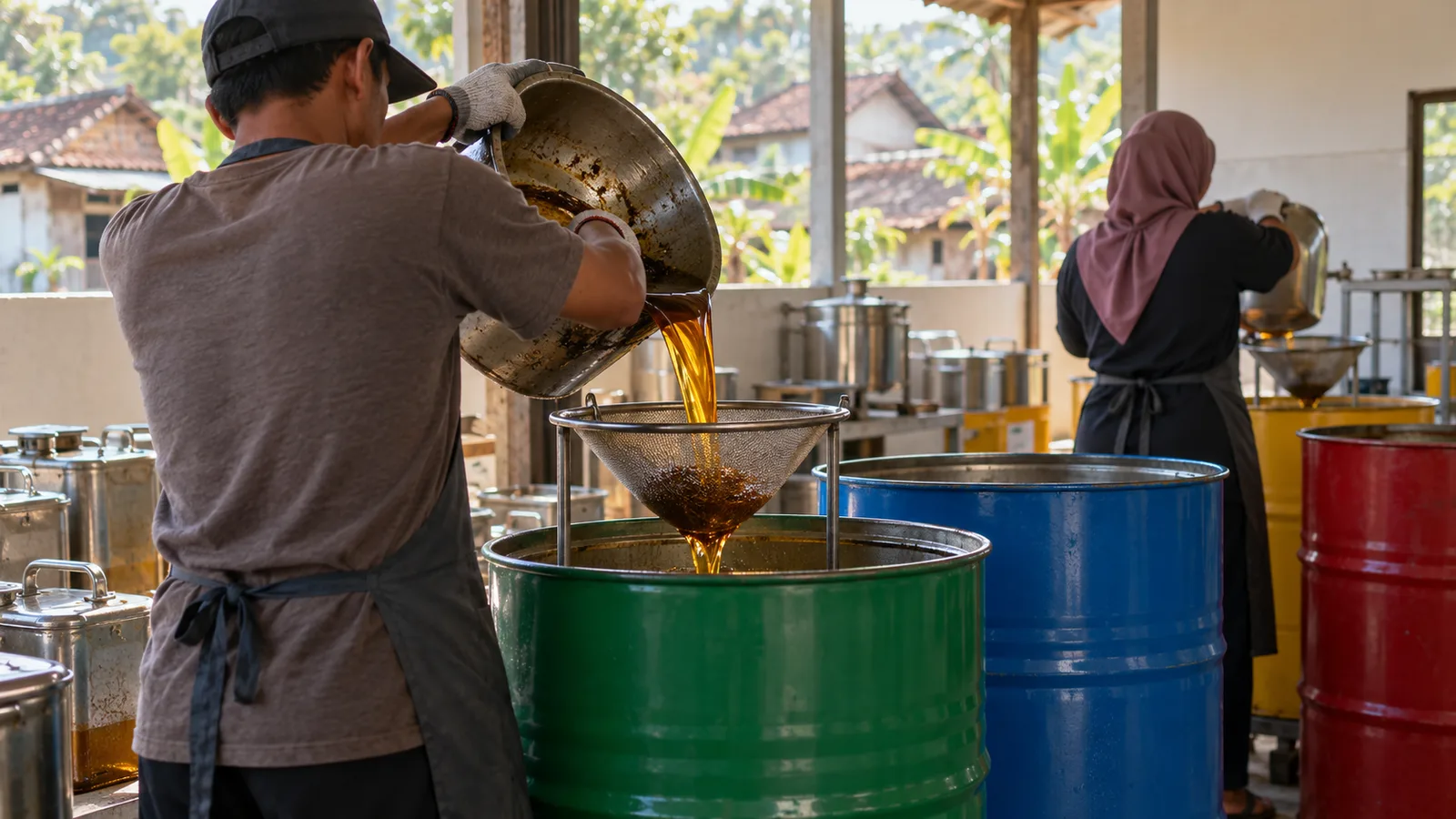
What Is HVO (Hydrotreated Vegetable Oil)? HVO Fuel Explained
HVO, or renewable diesel, is a drop-in diesel made by treating vegetable oils, used cooking oil or animal fats with hydrogen. Its meaning, production, feedstocks, producers and Indonesian track record.
Contents (9 sections)
HVO (hydrotreated vegetable oil) is a renewable diesel fuel made by treating vegetable oils, used cooking oil or animal fats with hydrogen. The process strips out the oxygen and leaves paraffinic hydrocarbons that are chemically almost identical to fossil diesel, so HVO can be blended with diesel in any proportion or used neat (HVO100) in engines approved for it. It is also known as renewable diesel or green diesel, and it is not the same fuel as biodiesel (FAME).
What does HVO stand for? Meaning and other names
HVO stands for Hydrotreated Vegetable Oil; some sources say Hydrogenated Vegetable Oil. According to Neste, both terms date from before 2010, when only vegetable oils were used as feedstock. Today much HVO is made from wastes and residues, but the name has stuck. Other names for the same type of fuel include:
- Renewable diesel, the usual term in the United States;
- Green diesel, the product name used for the Ecofining technology of Honeywell UOP and Eni;
- HDRD (hydrogenation-derived renewable diesel), and in the EN 15940 standard, "paraffinic diesel fuel from hydrotreatment";
- HVO100, which simply means 100% HVO with no fossil diesel. In the Netherlands it is sold as Blauwe Diesel; the Dutch motoring club ANWB explains that "HVO staat voor Hydrotreated Vegetable Oil" (HVO stands for Hydrotreated Vegetable Oil).
The jet-fuel cousin made by the same route is called HEFA (hydroprocessed esters and fatty acids). For a side-by-side comparison with FAME biodiesel, read HVO vs biodiesel: differences, B100 vs HVO and where SAF fits.
How is HVO made?
HVO is made in a hydroprocessing unit, either a dedicated biorefinery or a converted oil refinery. The main steps are:
- Pretreatment. Waste and residue oils often contain contaminants such as phosphorus, silicon, sodium and calcium, according to engineers at catalyst maker Topsoe. These are removed first because they would foul the hydrotreating catalyst.
- Hydrotreating (hydrodeoxygenation). The oil reacts with high-pressure hydrogen over a catalyst at around 300–400 °C, according to IEA Bioenergy. Oxygen is removed mainly as water (and partly as CO2 by decarboxylation), and the triglycerides split into straight paraffin chains. The glycerol backbone ends up as propane.
- Isomerisation. Straight paraffins wax up in the cold, so some are rearranged into branched molecules. Neste says this step can bring the melting point of a C18 paraffin from +28 °C down to −40 °C, which is how arctic grades are made.
- Fractionation. The product is separated into renewable diesel plus smaller amounts of renewable naphtha (gasoline components) and gases such as propane. Some plants also cut a jet-fuel fraction for SAF.
Several licensed technologies use this route: Neste's own NEXBTL, Ecofining from Honeywell UOP and Eni, Topsoe's HydroFlex, and Vegan from Axens. Refineries can also feed a small share of vegetable oil into existing units alongside fossil feed, known as co-processing. The result is a fuel with only partly renewable content.
What is HVO made from? Feedstocks and sustainability rules
Almost any fat or oil can be hydrotreated. Neste lists used cooking oil, animal fat waste, palm fatty acid distillate (PFAD, a residue from refining food-grade palm oil), palm oil mill effluent (POME) oil, technical corn oil, crude tall oil, fish fat, and vegetable oils such as rapeseed, soybean, sunflower and camelina. The company reported that wastes and residues made up 95% of its feedstock in 2025. In the US, Diamond Green Diesel uses recycled animal fats, used cooking oil and inedible corn oil.
Waste oils are limited. The International Energy Agency (IEA) expects demand for residue oils such as used cooking oil, tallow and POME to rise 70% to 30 million tonnes a year by 2030, nearly 80% of the estimated supply potential.
In the European Union, which feedstock is used decides how much HVO counts towards targets under the Renewable Energy Directive (RED III):
- Used cooking oil and category 1 and 2 animal fats are listed in Annex IX Part B of the Renewable Energy Directive. Their contribution is capped at 1.7%, although member states may raise the limit where justified.
- POME and empty palm fruit bunches are listed in Annex IX Part A as advanced feedstocks.
- High indirect land-use change (ILUC) risk feedstocks are capped at each member state's 2019 consumption and must fall gradually to 0% by 31 December 2030 at the latest. Under Delegated Regulation (EU) 2019/807, a crop is high-risk if more than 10% of its expansion goes into high-carbon-stock land. The regulation's data put 45% of palm oil's expansion since 2008 on forested land and 23% on wetlands including peatland, the only crop above the threshold.
- PFAD is not named in the directive. A 2021 Dutch government factsheet described its status in EU rules as unclear and said the Netherlands treats it as a co-product that is not eligible for double counting.
The EU rules affect how HVO from palm-based feedstock counts towards EU targets. They do not ban Indonesia from producing biofuels, as we explained in this fact check.
HVO properties and standards
HVO is tested against EN 15940, the European standard for paraffinic diesel. Its Class A requires a density of 765–800 kg/m³. In the US it meets the ASTM D975 diesel specification. Typical values from Neste and the US Department of Energy's Alternative Fuels Data Center (AFDC) are:
- Cetane number above 70 (AFDC: 70–85), against 40–55 for fossil diesel;
- Density around 780 kg/m³, below the 820 kg/m³ minimum of the EN 590 diesel standard;
- Energy content of 44.1 MJ/kg, or 34.4 MJ per litre, 4.4% less per litre than fossil diesel;
- Practically no sulphur, aromatics or oxygen, and storage stability similar to fossil diesel.
Because of its low density, HVO in Europe is either sold neat under EN 15940 or blended into EN 590 diesel only as far as the blend still meets the density minimum.
Where is HVO used?
Most HVO goes into road transport. California is the largest single market. The US Energy Information Administration (EIA), citing state data, reported that renewable diesel made up nearly 65% of the distillate fuel used for transport in California in the third quarter of 2024. According to AFDC, nearly all renewable diesel produced in or imported into the US is used in California because of the economic benefits there. In Europe, HVO is sold neat at filling stations in countries such as Finland, Sweden and the Netherlands. Demand also depends on policy: the IEA noted that after Sweden cut its transport greenhouse-gas reduction target in 2023, the country's renewable diesel demand fell by nearly 90%.
Who produces HVO?
| Producer | Capacity (as reported) | Notes |
|---|---|---|
| Neste (Finland) | About 5.5 million tonnes a year of renewable products | Porvoo, Rotterdam, Singapore and a joint operation at Martinez, California. The Rotterdam expansion, due in 2027, will raise capacity to 6.8 million tonnes. In 2025 Neste produced 3.31 million tonnes of renewable diesel and 0.84 million tonnes of SAF. |
| Diamond Green Diesel (US) | About 1.2 billion gallons a year | Joint venture of Darling Ingredients and Valero; plants at St. Charles (Louisiana) and Port Arthur (Texas). Figure from Darling's 2024 annual report. |
| Eni / Enilive (Italy) | 1.65 million tonnes a year of biorefining capacity (September 2025) | Venice and Gela; targets above 3 million tonnes in 2028 and above 5 million tonnes in 2030. |
| PETRONAS, Enilive and Euglena (Malaysia) | About 650,000 tonnes a year of feedstock | Pengerang, Johor; final investment decision July 2024; SAF, HVO and bio-naphtha; targeted to start in the second half of 2028. |
| Pertamina (Indonesia) | About 3,000 barrels per day (Cilacap phase 1) | Phase 2 (6,000 barrels per day, HVO or SAF) is targeted for full operation in 2029. |
How much does HVO cost compared with diesel?
There is no public benchmark retail price for HVO in Indonesia. In the US, the AFDC Alternative Fuel Price Report for July 2026 put the average retail price of renewable diesel in California at USD 6.42 per gallon, USD 0.03 above diesel in the state (USD 6.38). That near-parity reflects California's incentives. On the production side, a 2020 IEA Bioenergy study found feedstock makes up 65–80% of HVO production costs, which is why waste oils and their prices dominate the business.
HVO in Indonesia
Indonesia's mandatory biofuel at the pump is FAME biodiesel, now at B50 since 1 July 2026. ESDM Ministerial Decree 113/2026 on the phasing of biofuels also covers bio-hydrocarbon diesel, but the reports we found give no blending stages for it. Pertamina's HVO work so far:
- 2020, Dumai: on 2–9 July 2020 Pertamina's Dumai refinery processed 100% refined palm oil (RBDPO) into D100 bio-hydrocarbon diesel, at about 1,000 barrels per day, using the Merah Putih catalyst developed with the Bandung Institute of Technology (ITB).
- Cilacap green refinery, phase 1: producing HVO from RBDPO, marketed as Pertamina Renewable Diesel (Pertamina RD). CNBC Indonesia reported output of 2,500–3,000 barrels per day in October 2022. The ISCC-certified product had been accepted in Europe, mainly in Germany and France. Cilacap's general manager said the certification put the carbon reduction at 65–70% compared with conventional fuel.
- Cilacap biorefinery, phase 2: 6,000 barrels per day in total, using used cooking oil, crude palm oil and POME to make SAF or HVO with Topsoe's HydroFlex technology. In September 2026 Pertamina Patra Niaga put the investment at about USD 1.1 billion, said groundbreaking took place in February 2026, and set full operation for 2029. The previous target was 2026.
- Plaju: a 20,000 barrel-per-day green refinery was planned in 2023 for 2027 at about USD 200 million. We have found no recent update.
FAQ
Is HVO the same as biodiesel?
No. Biodiesel (FAME) is an ester made with methanol and contains oxygen; HVO is a hydrocarbon made with hydrogen. See our HVO vs biodiesel comparison.
What does HVO100 mean?
Neat HVO with no fossil diesel blended in. It is meant for engines whose makers approve fuels meeting EN 15940.
Is HVO better for the climate?
It depends on the feedstock. AFDC, citing California data, says renewable diesel cuts carbon intensity by 65% on average compared with petroleum diesel. Waste-based HVO generally scores better than HVO from crops linked to land-use change.
Can HVO be made from palm oil?
Yes. Pertamina's Cilacap and Dumai output used refined palm oil, and Neste uses palm residues such as PFAD and POME oil. In the EU, however, palm oil is classed as a high ILUC-risk feedstock and its contribution to targets is being phased out by 2030.
Sources & references
- Neste, "What is HVO" — https://www.neste.com/products-and-innovation/neste-my-renewable-diesel/what-is-hvo
- Neste, "Neste Renewable Diesel Handbook" (October 2020) — https://www.sustainable-ships.org/s/2020-10-Neste-Renewable-Diesel-Handbook.pdf
- Neste, "Renewable raw materials" — https://www.neste.com/renewable-raw-materials
- Neste, "Financial Statements Release 2025" (5 February 2026) — neste.com
- Neste, "Production" and "Rotterdam" — https://www.neste.com/about-neste/who-we-are/production; https://www.neste.com/about-neste/who-we-are/production/rotterdam
- ANWB, "Blauwe Diesel" — https://www.anwb.nl/auto/brandstof/blauwe-diesel
- Diamond Green Diesel, "Science & process" — https://www.diamondgreendiesel.com/science-process
- Darling Ingredients, Form 10-K for fiscal 2024 (SEC) — sec.gov
- Zeuthen & Rasmussen (Topsoe), "Future fuel – the challenges associated with renewable diesel hydrotreating", PTQ (May 2016) — digitalrefining.com
- IEA Bioenergy Task 41, "Advanced Biofuels – Potential for Cost Reduction" (February 2020) — ieabioenergy.com
- IEA, "Renewables 2024" (October 2024) — iea.blob.core.windows.net
- Honeywell UOP, "Eni using Ecofining technology to meet European biofuel demand" (20 April 2021) — uop.honeywell.com
- Hydrocarbon Processing, "Axens tapped for 3 new Vegan licenses for SAF and renewable diesel production" (8 January 2025) — hydrocarbonprocessing.com
- EU, Directive (EU) 2018/2001, consolidated version of 16 July 2024 — publications.europa.eu
- EU, Commission Delegated Regulation (EU) 2019/807 (13 March 2019) — publications.europa.eu
- Rijksdienst voor Ondernemend Nederland, factsheet on PFAD (September 2021) — officielebekendmakingen.nl
- U.S. Department of Energy, Alternative Fuels Data Center, "Renewable Diesel" — https://afdc.energy.gov/fuels/renewable-diesel
- U.S. Department of Energy, "Clean Cities and Communities Alternative Fuel Price Report, July 2026" — afdc.energy.gov
- DieselNet, "EU: Fuels: Automotive Diesel" (revision 2024.08) — https://dieselnet.com/standards/eu/fuel_automotive.php
- EIA, "Consumption of renewable diesel continues general growth trend on the U.S. West Coast" (18 February 2025) — eia.gov
- Eni, press release on the new Sannazzaro de' Burgondi biorefinery project (23 September 2025) — eni.com
- Eni/Enilive, press release on the PETRONAS–Enilive–Euglena biorefinery in Malaysia (26 July 2024) — eni.com
- CNBC Indonesia, "Pertamina Siap Produksi Green Diesel D-100 Pertama di RI" (15 July 2020) — cnbcindonesia.com
- CNBC Indonesia, "Top! Produk Pertamina Ini Diakui Dunia Tekan Emisi Karbon 70%" (29 October 2022) — cnbcindonesia.com
- Indonesia Business Post, "Kilang Pertamina Internasional spearheads green refinery expansion for enhanced biofuel production" (17 July 2023) — indonesiabusinesspost.com
- Oil & Gas Journal, "Pertamina secures feedstock for Cilacap refinery's SAF-HVO expansion" (19 December 2024) — ogj.com
- Akurat, "Telan Rp17 Triliun, Biorefinery Cilacap Beroperasi Penuh pada 2029" (10 September 2026) — akurat.co
- Listrik Indonesia, "Bedah Kepmen Pemanfaatan BBN, Jalan Panjang Menuju B50" (14 April 2026) — listrikindonesia.com
Stay on top of Indonesian biodiesel
The weekly newsletter: the week’s key news, prices and data in one email every Friday. Or follow our channels for daily prices.